
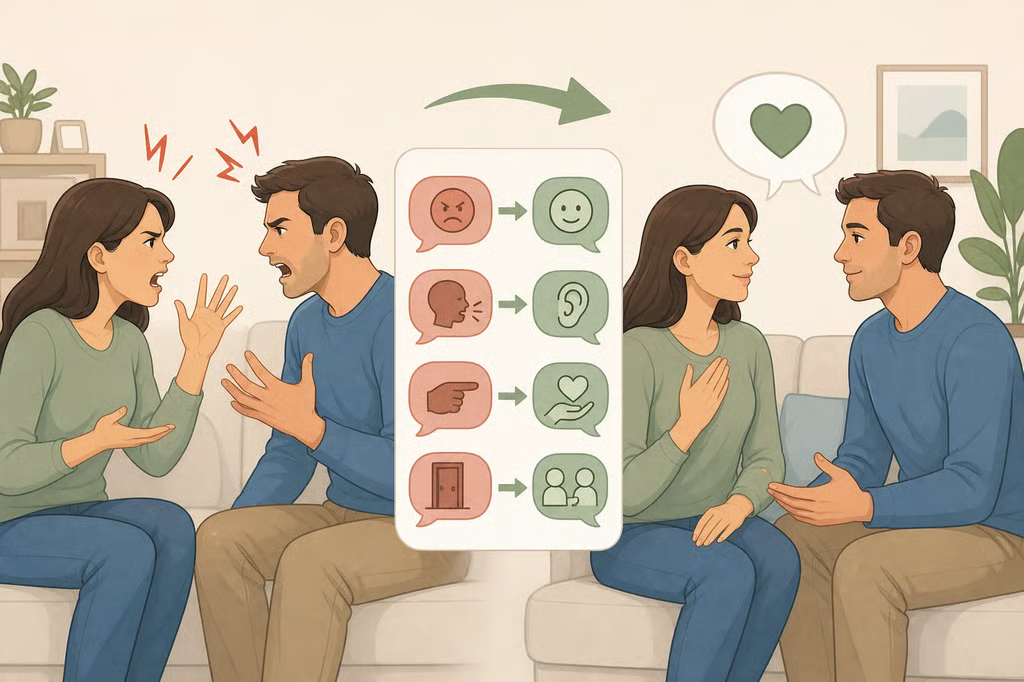
Gottman Four Horsemen and their antidotes: How to replace criticism, contempt, defensiveness, and stonewalling
A conversation about dishes can start with a reasonable complaint, turn into “You never help,” and end with an eye-roll or someone walking out of the room. The unfinished chore may be the original problem, but the pattern driving the argument has changed.
The Gottman Four Horsemen and their antidotes give couples a way to notice that shift. Criticism, contempt, defensiveness, and stonewalling are observable communication behaviors, not permanent personality flaws. They can become stress responses, coping strategies, and learned habits when people feel unheard or overwhelmed, as ReFresh Psychotherapy explains.
This guide shows how to identify each pattern, choose the matching replacement move, and repair the conversation if the moment has already gone sideways. The goal is not to eliminate disagreement. It is to change the form the disagreement takes.
What are the Gottman Four Horsemen?
Name the behavior precisely. Calling a partner “impossible” adds another attack. Identifying criticism or stonewalling gives both people something specific to notice and change.
Recognize criticism
Criticism turns a complaint about one behavior into a judgment about character. “The dishes are still in the sink” addresses a household task. “You never do what you say you will” treats the task as proof of a supposedly defective personality.
Words such as “always,” “never,” and “what’s wrong with you?” often signal criticism. A complaint can still be firm while staying focused on the issue: “I’m frustrated that the dishes weren’t finished. Could you take care of them before bed?” The Gottman Institute distinguishes criticism from a complaint, describing criticism as an attack on character rather than a statement of need.
Notice contempt
Contempt communicates superiority. Sarcasm, mockery, name-calling, sneering, hostile humor, and eye-rolling can send the message that one partner is better than the other, according to the Gottman Institute’s explanation of contempt.
In the dishes argument, contempt sounds less like “I need more help” and more like, “Amazing. Should someone give you a medal for putting one plate away?” The original problem becomes harder to solve because the conversation now involves humiliation and disrespect.
Catch defensiveness
Defensiveness can look like explaining, counterattacking, or presenting yourself as the innocent victim. “I only snapped because you were nagging,” or “You do this too,” may feel like self-protection, but the response moves away from the concern.
Disagreeing with an unfair accusation is not automatically defensiveness. The pattern appears when the response refuses any responsibility and sends the criticism back. The Couples Center describes defensiveness as refusing responsibility through righteous indignation, victimhood, or counterattack.
Identify stonewalling
Stonewalling is withdrawing while a partner is still trying to communicate. It can involve silence, leaving the room, staring at a phone, showing no facial response, or refusing to engage. The Couples Center’s guidance on stonewalling distinguishes this withdrawal from a mutually agreed pause.
Sometimes stonewalling is deliberate avoidance. Sometimes a person is overwhelmed and no longer able to participate productively. The effect can still become a pursue-withdraw cycle: one partner pushes harder for a response, and the other retreats further.
Why contempt deserves prompt attention
Criticism says, “This behavior is upsetting me.” Contempt says, “You are beneath me.” That difference makes contempt the most urgent of the four patterns to address. The Gottman Institute identifies it as the strongest predictor of divorce in Gottman’s research, while also describing it as a behavior that can be changed.
Research discussed by the Gottman Institute found an association between high contempt and more frequent infectious illness. That association does not prove that contempt alone weakens immunity, and it should not be treated as a medical conclusion. It does underline the seriousness of ongoing hostility inside a relationship.
The antidote is not one perfectly delivered sentence in the middle of a heated argument. It is a daily culture of fondness, respect, and appreciation, along with a clear boundary against mockery. Thank a partner for a small act, name something they handled well, or recall a difficult season the two of you managed together. These gestures are not meant to cover up unresolved problems. They help keep resentment from becoming the only lens through which either person sees the relationship.
If contempt has become routine rather than occasional, daily compliments are unlikely to be enough. Address the pattern directly, and consider professional support.
How to replace the Four Horsemen
Use each step as a practical replacement move. Start by watching for your own pattern rather than diagnosing your partner.
1. Replace criticism with a gentle start-up
Spot the signal: The complaint includes a character judgment, a sweeping word such as “never,” or an accusation about motives.
Make the replacement: Describe the situation, name your feeling or need, and make one specific request.
Try: “The dishes are still in the sink, and I’m frustrated. Could you wash them before we go to bed?”
This does not require pretending the unfinished task is fine. It simply gives the other person something concrete to respond to instead of asking them to defend their entire character. The Gottman Institute’s gentle start-up guidance follows the same sequence: describe what happened without blame, express how it feels, and state what would help.
A gentle start-up cannot solve a chore arrangement the couple has never agreed on. If dishes keep becoming a flashpoint, stop trying to settle the division of work in the middle of the argument. Discuss who handles which tasks at a calmer time.
2. Replace defensiveness with partial responsibility
Spot the signal: The first response is “but,” an explanation of why the other person caused the problem, or a quick reminder of their mistakes.
Make the replacement: Find the small part that belongs to you and name it. The “5%” is a practical exercise, not a literal calculation of blame.
Try: “You’re right that I was short with you,” or, “I did say I would handle the dishes, and I didn’t.”
Taking responsibility does not mean accepting every accusation or taking the blame for the entire conflict. It gives the other person something to respond to besides a counterattack. ReFresh Psychotherapy recommends taking responsibility as the antidote to defensiveness.
If an apology is immediately used to demand surrender on every other issue, return to one concrete point: “I’m owning that I was dismissive. I still want to talk about how cleanup is divided.”
3. Replace stonewalling with a structured break
Spot the signal: Your body feels overwhelmed, your thoughts are racing, or you are staring blankly and no longer taking in what your partner is saying.
Make the replacement: Announce the break, give a return time, and state that you intend to re-engage.
Try: “I’m too overwhelmed to do this well. I need 20 minutes, and I’ll come back at 8:30 so we can finish.”
A flooded nervous system may need approximately 20 to 30 minutes to return to baseline, according to research summarized by ReFresh Psychotherapy. Use the pause to calm your body. Walk, breathe slowly, stretch, drink water, or step outside. Rehearsing the argument and collecting evidence against your partner will not make the return conversation easier.
The return time is part of the antidote. Without it, “I need space” can feel like abandonment or become a way to avoid the issue indefinitely. When you return, begin with one sentence of ownership: “I shut down. I’m back.”
4. Replace contempt with respect and appreciation
Spot the signal: Sarcasm, eye-rolling, a sneer, name-calling, or the urge to make the other person feel foolish has entered the exchange.
Make the replacement: Stop the attack, state the boundary, and return to a specific need.
Try: “I’m not willing to keep talking while we’re mocking each other. I need help with cleanup, and I’ll talk about that without insults.”
Outside conflict, make one genuine appreciation specific: “Thank you for getting the lunches ready,” or, “I noticed you called the plumber when I was busy.” Connect Couples Therapy describes building a culture of appreciation as a proactive antidote to contempt.
The appreciation must be real. Forced praise can feel insulting, especially when a serious issue is still unresolved. Pair respect with a firm boundary: contempt cannot become the household’s normal way of talking.
Practice before the next argument
These antidotes are difficult to use when both people are fully activated. Practice them in small, ordinary moments instead of waiting for the biggest fight, as Connect Couples Therapy recommends.
Choose a pause phrase together, such as “Can we reset?” The person who calls the pause agrees to return. The other person agrees not to follow, press for an immediate answer, or treat the break as proof that the relationship is doomed.
For one week, track your own first signal. Write down:
- What topic started the tension
- Which Horseman appeared first
- What you said or did
- Whether you tried an antidote
- What helped you reconnect
- One sentence to try next time
Look for patterns rather than building a case against a partner. Maybe criticism appears during bedtime chaos, defensiveness during money conversations, or stonewalling when one person is looking at a phone. That information shows where practice is most useful.
Repair the conversation when you miss the moment
Perfect timing is not required. A repair attempt can be an apology, a request to restart, a softer tone, or humor that reduces tension without mocking either person. Try: “That came out as an attack. Can I say it again?”
Return to the dishes example. After walking away, one partner might say, “I shut down instead of telling you I needed a break. I’m back. Can we talk about cleanup?” The other might answer, “I criticized you instead of making a request. I need the dishes handled tonight.” The chore remains, but the conversation has a better chance of solving it.
The Four Horsemen framework is most useful when both partners can use it in good faith. If one partner is intimidated, controlled, threatened, or afraid of the other, do not treat that as a shared communication problem. Better phrasing cannot make an unsafe relationship safe. Prioritize confidential individual support and safety planning through an appropriate local service.
Start with one observable signal this week. Choose its antidote, practice the sentence while calm, and agree on how a pause will end. The next argument may still involve dirty dishes. The practical win is catching the moment when the dishes stop being the only issue.
