
How to clean a wooden cutting board step by step
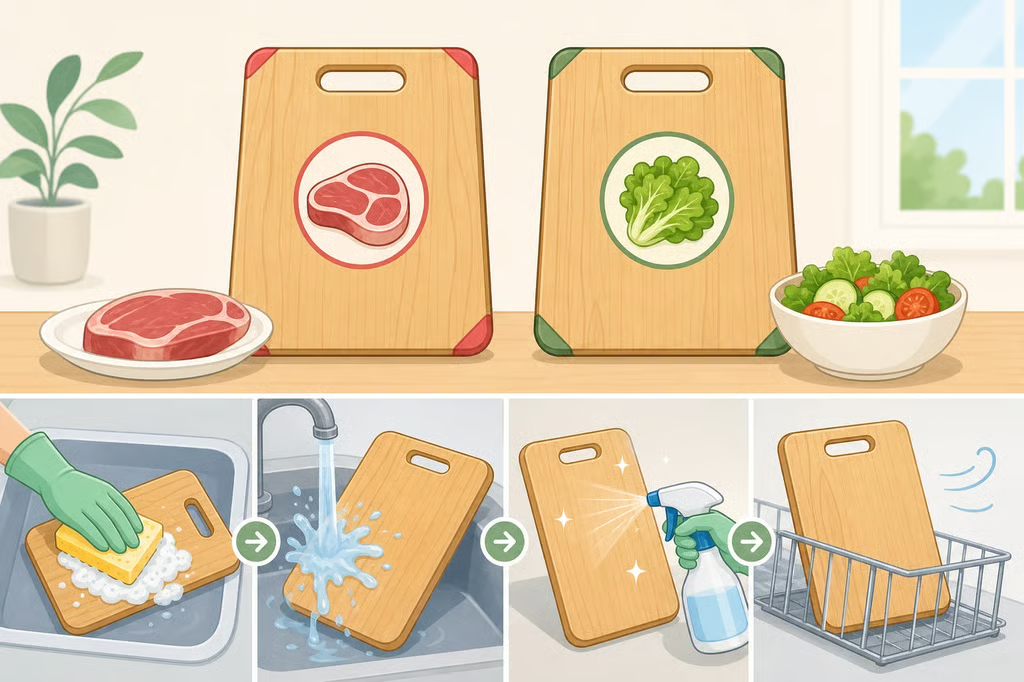
To learn how to clean a wooden cutting board, follow this sequence: remove food debris, wash with hot, soapy water, rinse, sanitize, rinse again, and let the board air-dry completely. Use separate boards for raw meat, poultry, and seafood and for ready-to-eat foods such as bread, fruit, vegetables, and cheese. That separation limits the chance of carrying raw-food residue onto something that will not be cooked.
The wood itself is not automatically the problem. A study of 100 household cutting boards found Listeria monocytogenes on 3% of samples and E. coli on 5%, with no significant difference between wood and plastic for those pathogens. The same study found that 87% of food handlers used one board for every type of food, making food separation and consistent cleaning important parts of the routine. The study points to handling, cleaning, wear, and cross-contamination as the details worth controlling at home.
Separate raw and ready-to-eat foods first
Before washing the board, decide which foods it will handle. Keep one board for raw meat, poultry, and seafood, and another for foods that will be served without further cooking. If the boards look alike, label them or use different colors so the distinction is easy to remember.
Sana Mujahid, PhD, manager of food safety research and testing at Consumer Reports, recommends one board for raw animal foods and another for ready-to-eat items. Consumer Reports also recommends washing both wood and plastic boards with hot, soapy water after every use.
Do not move directly from raw chicken or meat to fruit, bread, vegetables, or cheese on the same unwashed board. Even if the board looks clean, a quick wipe does not replace washing and sanitizing.
A study of cutting boards in commercial kitchen settings found that Campylobacter survived on wood and stainless steel for three hours, while survival on plastic lasted longer under the tested conditions. The research involved chicken juice and controlled kitchen tests, so it is not a measurement of every household kitchen. It does support cleaning the board promptly instead of leaving it beside the sink. The research also found that scraping, running water, and other tested practices did not eliminate contamination to a safe level.
How to wash wooden cutting boards with soap and water
Iowa State University Extension recommends cleaning and sanitizing cutting boards between uses. The steps below follow that more thorough sequence. Washing removes food and residue; sanitizing is the additional step intended to reduce remaining microorganisms.
1. Remove food debris
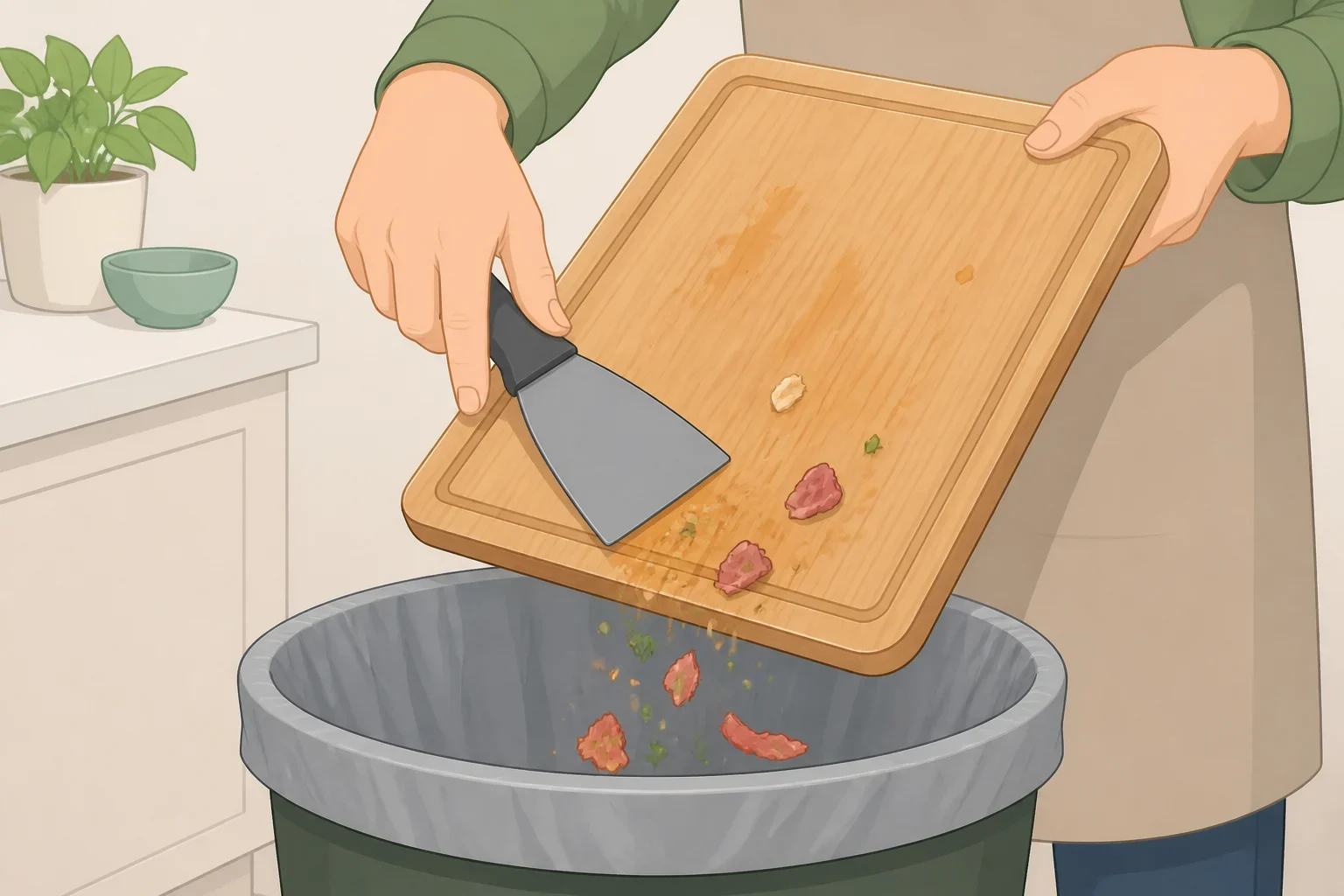
Scrape away peels, crumbs, meat scraps, and other visible residue. Removing the food first lets the wash water reach the board’s surface instead of simply moving scraps around.
Use the board reserved for ready-to-eat foods before cutting fruit, bread, vegetables, or cheese. If only one board is available, wash and sanitize it fully before changing from raw food to anything that will not be cooked.
2. Wash the board with hot, soapy water
Wash the board after every use with hot, soapy water. This is the everyday answer to how to wash wooden cutting boards, whether the board held raw animal food or ready-to-eat food. Consumer Reports recommends the same habit for both wood and plastic.
Use enough water and dish soap to clean the entire surface, including the edges and any shallow knife marks. Work the soap over the board, then rinse away the loosened residue. Do not rely on a quick wipe, a plain-water rinse, or scraping alone.
3. Rinse with clean water
Rinse the board with clean water after washing. This removes soap and food residue before the sanitizing step.
Rinsing is not the same as sanitizing. Iowa State Extension lists washing, rinsing, sanitizing, and air-drying as separate parts of the process, so complete each step rather than stopping once the board looks clean.
4. Sanitize the board
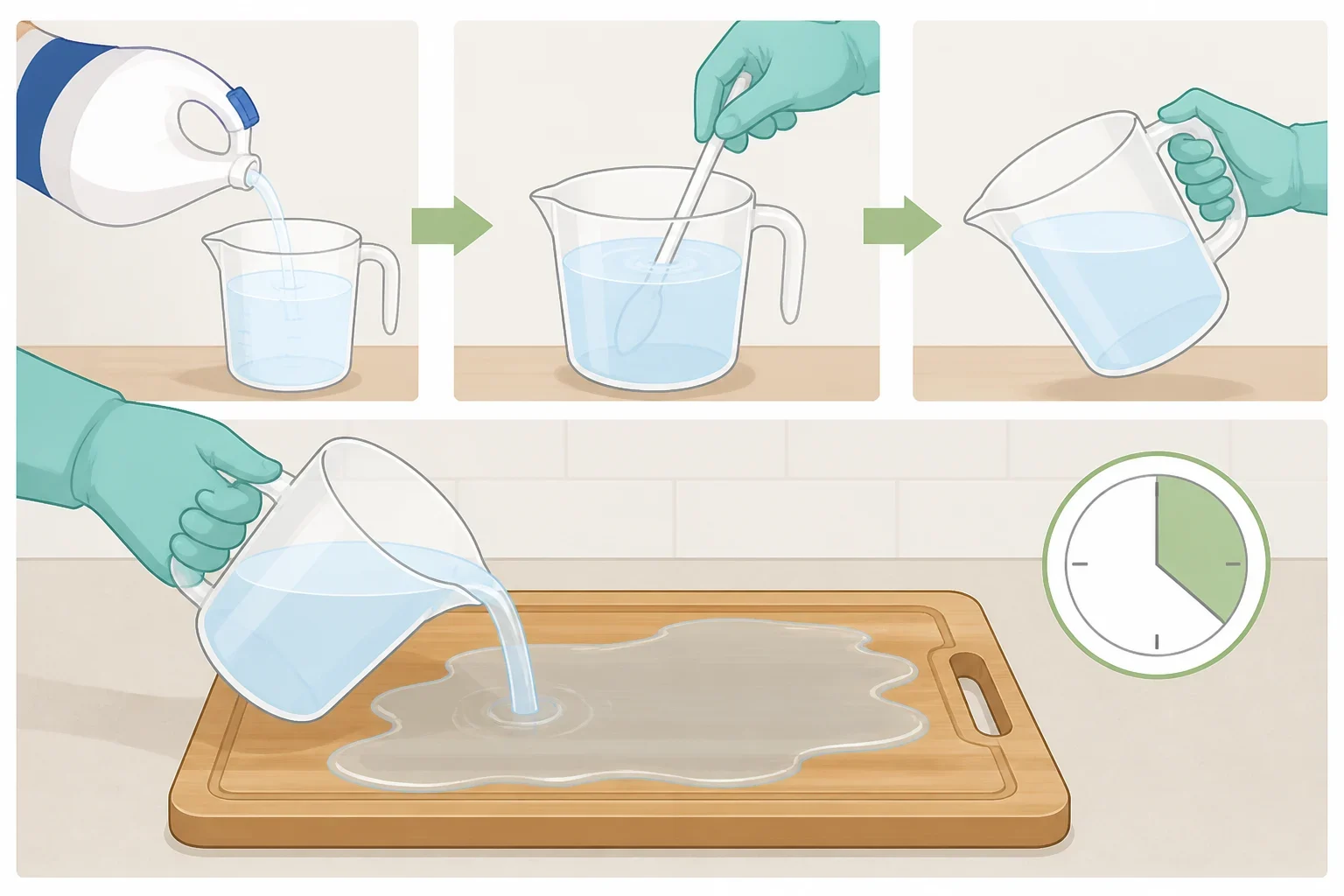
For a bleach-water solution, mix 1 tablespoon of unscented liquid chlorine bleach at a 6.0% to 8.25% concentration with 1 gallon of warm or cool water. Flood the cleaned board’s surface with the solution and let it stand for several minutes. Iowa State University Extension provides this dilution as part of its cutting-board sanitation sequence.
Before mixing or applying the solution, check the bleach label and the board manufacturer’s care instructions. Use a bleach product labeled for food-contact surfaces, and do not use the mixture if the product directions or board instructions say otherwise. Keep the bleach solution separate from other cleaners.
A commercial sanitizing spray can be used instead if its label gives directions for use on the board and states how long the surface should remain wet. N.C. Cooperative Extension supports using commercial sprays according to their directions.
Sanitizing is especially useful after raw meat, poultry, or seafood. Guidance varies on whether it should happen after every type of food, with some recommendations describing it as periodic and extension guidance outlining it between uses. For the more cautious household routine, complete the wash-rinse-sanitize sequence after raw animal foods and whenever the board will be used for ready-to-eat food next.
5. Rinse again
Rinse the board with clean water after the sanitizing solution has stood for the instructed time. This second rinse removes the solution before the board is used for food preparation.
Do not simply wipe the solution away. The cited guidance calls for clear water after sanitizing, followed by thorough drying.
6. Air-dry completely
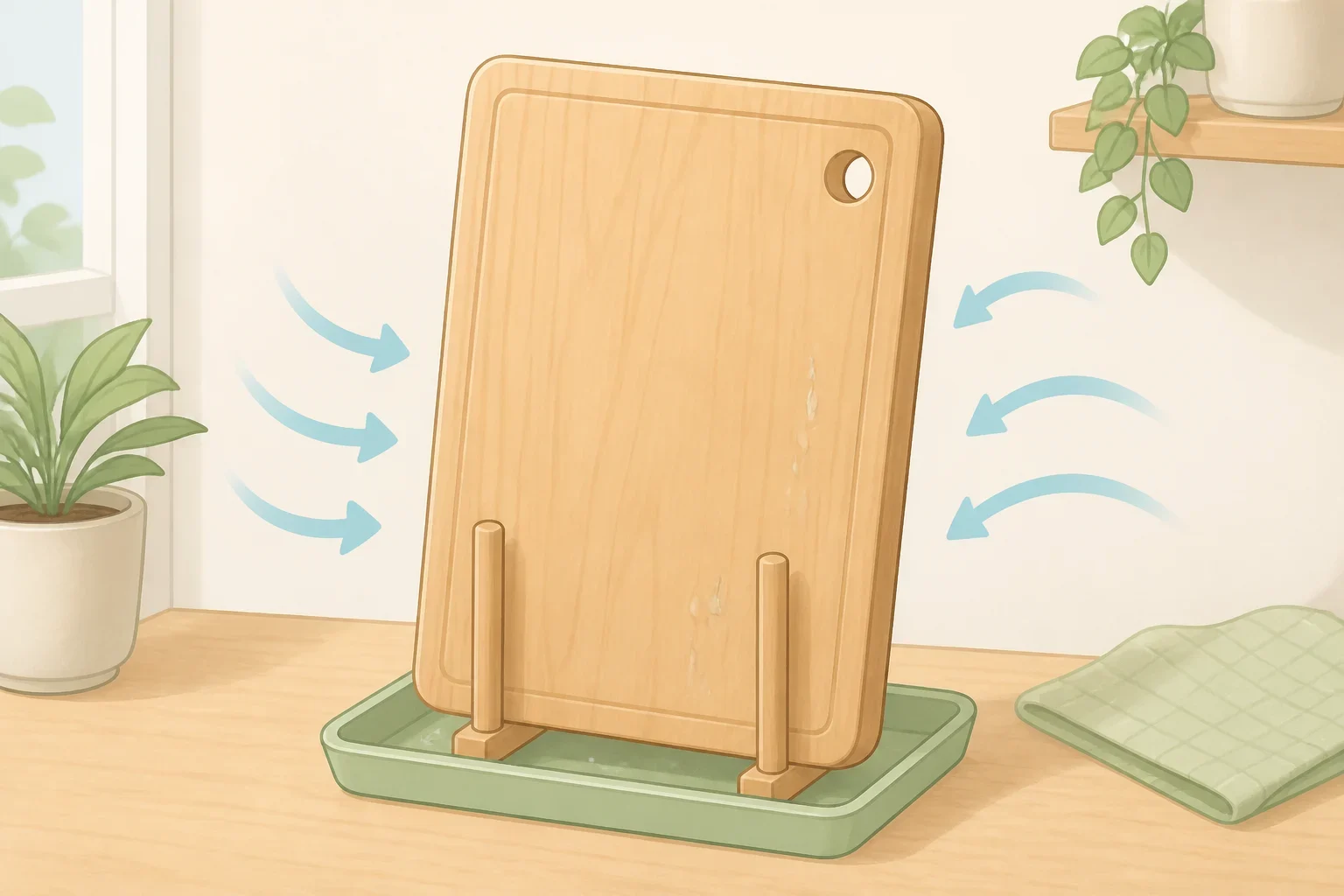
Let the board air-dry thoroughly before storing it. Place it where air can reach the surface, and do not stack it or put it in a cabinet while it is still wet. N.C. Cooperative Extension notes that trapped moisture can promote bacterial growth, while Consumer Reports recommends complete drying for the same reason.
Stand the board upright or lay it flat with airflow around it. A board can be clean and still be stored too soon. Wait until the surface is fully dry before putting it on a rack, in a drawer, or beneath another kitchen item.
Should a wooden cutting board go in the dishwasher?
Check the manufacturer’s instructions first. When those instructions are missing or unclear, hand-washing is the safer default for a wooden board.
UF/IFAS Extension says solid wood boards can be washed in a dishwasher, but laminated boards may crack and split. That distinction does not make every wooden board interchangeable. Check whether yours is made from a solid piece, laminated construction, or another assembled material before using the dishwasher. UF/IFAS Extension provides the solid-wood and laminated-board guidance.
If the care instructions do approve the dishwasher, let the board dry completely before storing it. If they do not, wash, rinse, sanitize, rinse again, and air-dry the board by hand.
Wooden cutting board care and cleaning
Washing and sanitizing handle food residue and contamination. They do not stop a board from wearing down, so inspect it when the board is dry.
Bamboo boards can be cleaned with hot, soapy water and sanitized if desired. Rubbing bamboo with mineral oil can help it retain moisture. UF/IFAS Extension includes mineral oil as part of bamboo board care.
The type of wood also affects how a board wears. Hardwoods such as maple and beech are often recommended for durability and their gentler effect on knife edges. Bamboo resists scarring but is hard enough to dull knives faster than softer wood or plastic. For a new wooden board, N.C. Cooperative Extension recommends a single solid piece of hard, close-grained wood such as hard maple or an equivalent.
Mineral oil is not a substitute for cleaning. Food debris still needs to be removed, and the board still needs to be washed, rinsed, sanitized according to the selected guidance, rinsed again, and dried.
Know when to replace the board
Inspect the board when it is dry. Look for deep grooves, cracks, splits, and areas where residue remains after washing. Consumer Reports says deep scratches and grooves can trap bacteria and recommends replacing any board that becomes heavily scarred.
The household-board study found biofilm-like structural characteristics on worn boards. That finding does not mean every knife mark contains harmful bacteria, but it does support taking severe wear seriously. The same study found that 75% of surveyed food handlers had used their boards for more than two years, a result that describes that study group rather than a universal replacement schedule. The study supports judging the board by its condition.
Replace the board when deep scarring or cracks make it difficult to clean reliably. A new board made from a single solid piece of hard, close-grained wood is one practical replacement choice.
A wooden board is worth keeping when it remains intact, washable, and easy to sanitize. Use separate boards when possible, clean after every use, complete the sanitation sequence after raw animal foods, and let the board dry fully. If deep grooves, cracks, or heavy scarring have taken over, replace it instead of continuing to scrub around the damage.
