
- Curtain Hacks to Make a Dark Living Room Brighter
- Check the window and room before buying anything
- Measure the rod for more natural light
- Calculate the curtain panel width
- Choose light-colored curtains for dark rooms
- Set up the daytime routine
- Establish the nighttime warmth routine
- Use the simplest solution that fits the room
Curtain Hacks to Make a Dark Living Room Brighter
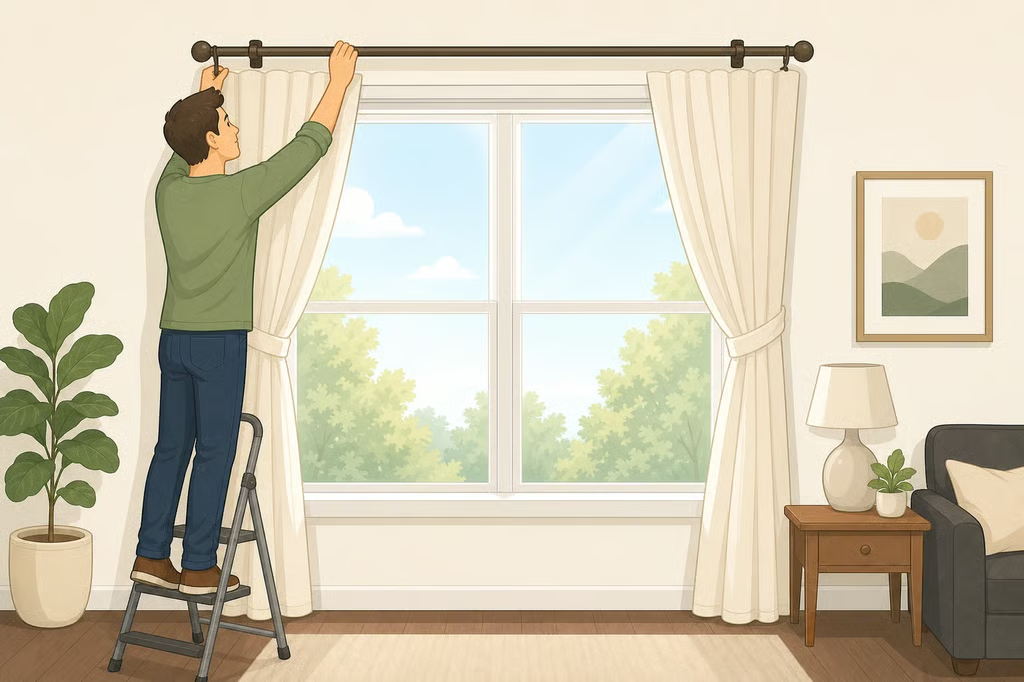
The most effective curtain hacks to make a dark living room look brighter do not involve adding more fabric to the window. They involve keeping open panels off the glass, extending the rod beyond the frame, and choosing a lighter fabric that does not visually weigh down the room.
Raising the rod can also make the ceiling appear taller. The Spruce cites designer Nina Magon’s recommendation to hang curtains 6 to 12 inches above the window frame, while designer Mayer says the extra height can make a room feel brighter and larger. The effect is visual, not a promise of more daylight. The window still determines how much natural light enters the room.
Warmth is a separate, useful consideration. Curtains can help reduce heat loss when they fit closely and cover the window properly, but daytime brightness calls for open panels, while nighttime warmth calls for closed ones. Treat those as two routines rather than expecting one arrangement to do everything at once.
Check the window and room before buying anything
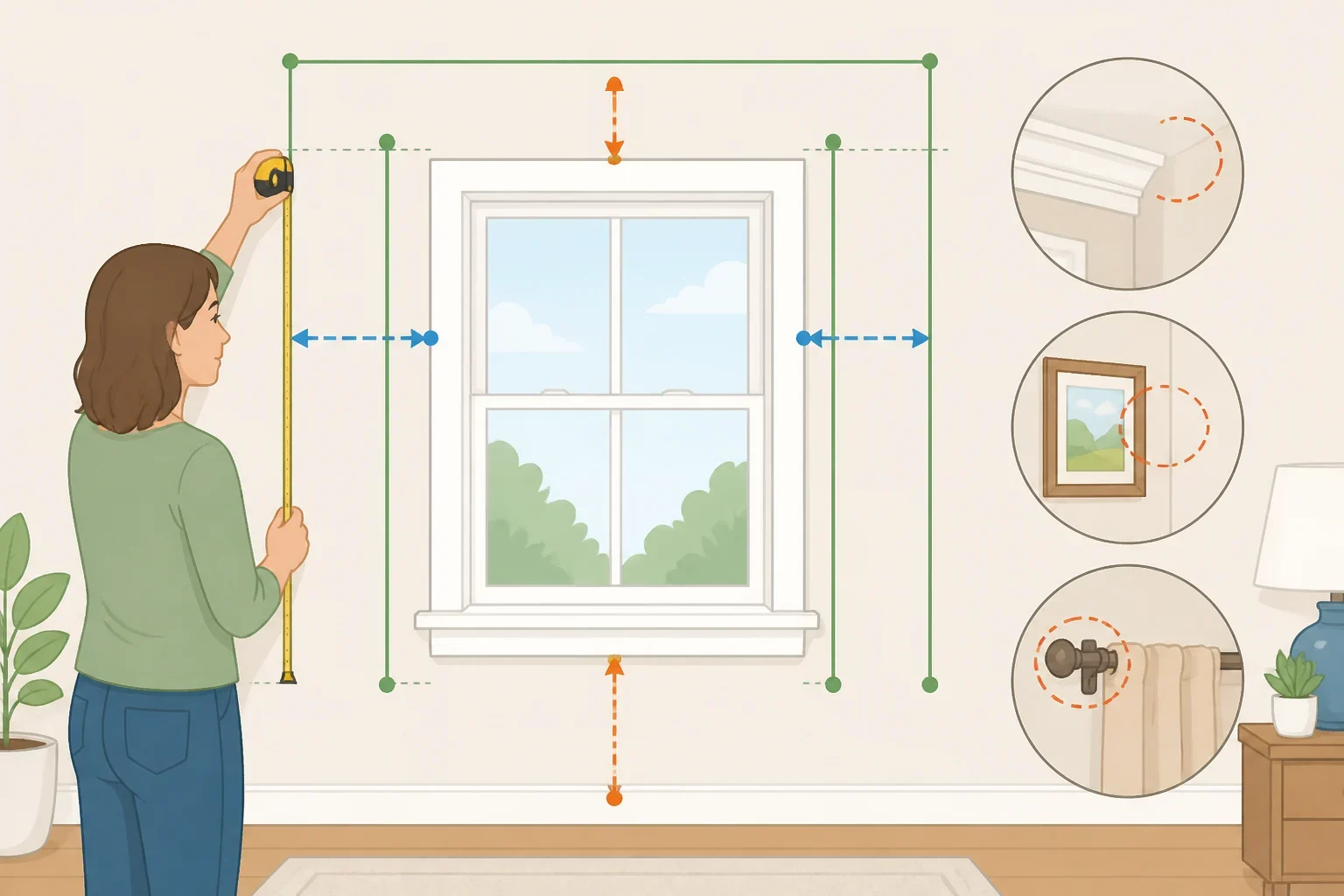
Start with the space around the window, not the curtain aisle. Measure the window frame, the distance from the top of the frame to the ceiling, and the distance from the frame to the nearest wall, door, or piece of furniture.
Use this checklist before choosing a rod or panels:
- Check whether a radiator or baseboard heater sits below the window. A floor-length curtain may interfere with heat circulation or create a practical nuisance, so measure the space before committing to that length.
- Check whether a door, cabinet, sofa, or adjacent window limits how far the curtain can extend to either side.
- Check the ceiling height. Most ready-made curtains measure 94 to 96 inches long, but that does not mean they will fit every room without hemming. The Spruce notes that this length is commonly used for standard residential ceiling height.
- Check whether the window is in a bay, corner, or unusually deep recess. A single straight rod may not suit the shape.
- Check the hardware instructions for the curtain weight and span. A wide rod with heavy lined panels may need the right brackets and center support.
- Check rental or homeowners association rules before drilling into the wall.
- Note what limits the daylight, including trees, a neighboring building, an overhang, or the direction the window faces. A higher rod can make the composition feel more open, but it cannot compensate for a window with very little available daylight.
If more than 18 inches of wall sits above the window, a ceiling-height arrangement may leave an awkward gap. The Spruce cites Mayer’s suggestion of adding a valance in that situation. That is an optional design solution, not the first thing to buy. Solve the rod placement, panel length, and daytime opening position before adding extra hardware or fabric.
Measure the rod for more natural light
Hang curtains higher and wider
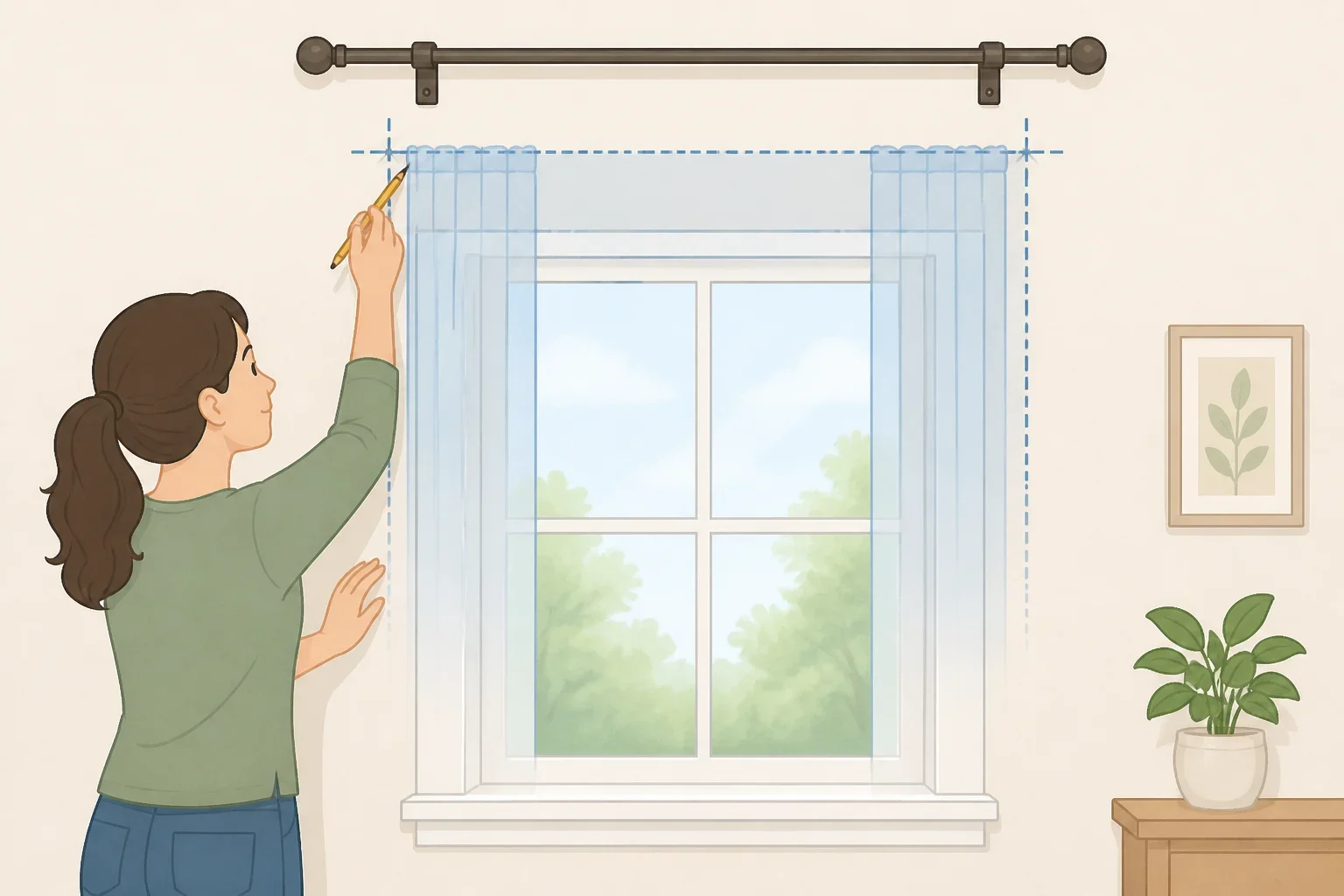
The basic curtain placement for more natural light has two parts: raise the rod and extend it beyond the window.
- Measure 6 to 12 inches above the top of the window frame. This is the suggested range cited by The Spruce from Nina Magon. Choose a height that leaves enough room for the brackets and still allows the panels to reach the floor.
- Measure 8 to 12 inches beyond each side of the frame. The extra width gives the panels somewhere to stack when they are open. If the fabric sits over the glass, it blocks part of the very daylight the room needs.
- Add the two side extensions to the window width. For example, a 60-inch-wide window with an 8-inch extension on each side needs a 76-inch rod: 60 + 8 + 8 = 76 inches. The rod may need to be slightly longer depending on the bracket design and the amount of overlap required in the middle. The Spruce supports the 8- to 12-inch extension recommendation.
- Mark both bracket positions before drilling. Measure from the top of the frame and from the nearest wall on each side. Use a level so the rod does not slope, then check that the brackets are positioned where the panels can open fully.
The height and width work together. Raising the rod without giving the panels room to move outward can leave them covering the glass or make the arrangement look disconnected from the window. Extending the rod without enough panel length can create a different problem, with fabric that looks skimpy or fails to reach the floor.
Calculate the curtain panel width
Curtain fullness determines whether the finished panels look softly gathered or stretched across the rod. The Spruce cites a recommendation of panels totaling 1.5 to two times the window width.
For the 60-inch window above:
- Minimum total panel width: 60 × 1.5 = 90 inches
- Fuller total panel width: 60 × 2 = 120 inches
- If using two equal panels, each panel should measure 45 to 60 inches wide
That calculation uses the window width, not simply the rod length. The extended rod gives the curtains space to clear the glass; the fullness calculation gives them enough fabric to drape properly when closed.
Check the package carefully. A pair of panels may list the width of each panel or the combined width, depending on the manufacturer. If the total width is less than the recommended range, the curtains may look flat when closed and may not cover the frame generously at night.
For a living room that needs to feel brighter, choose panels that can be pushed fully beyond the window during the day. A beautiful curtain that remains bunched across one side of the glass is still using up available light.
Choose light-colored curtains for dark rooms
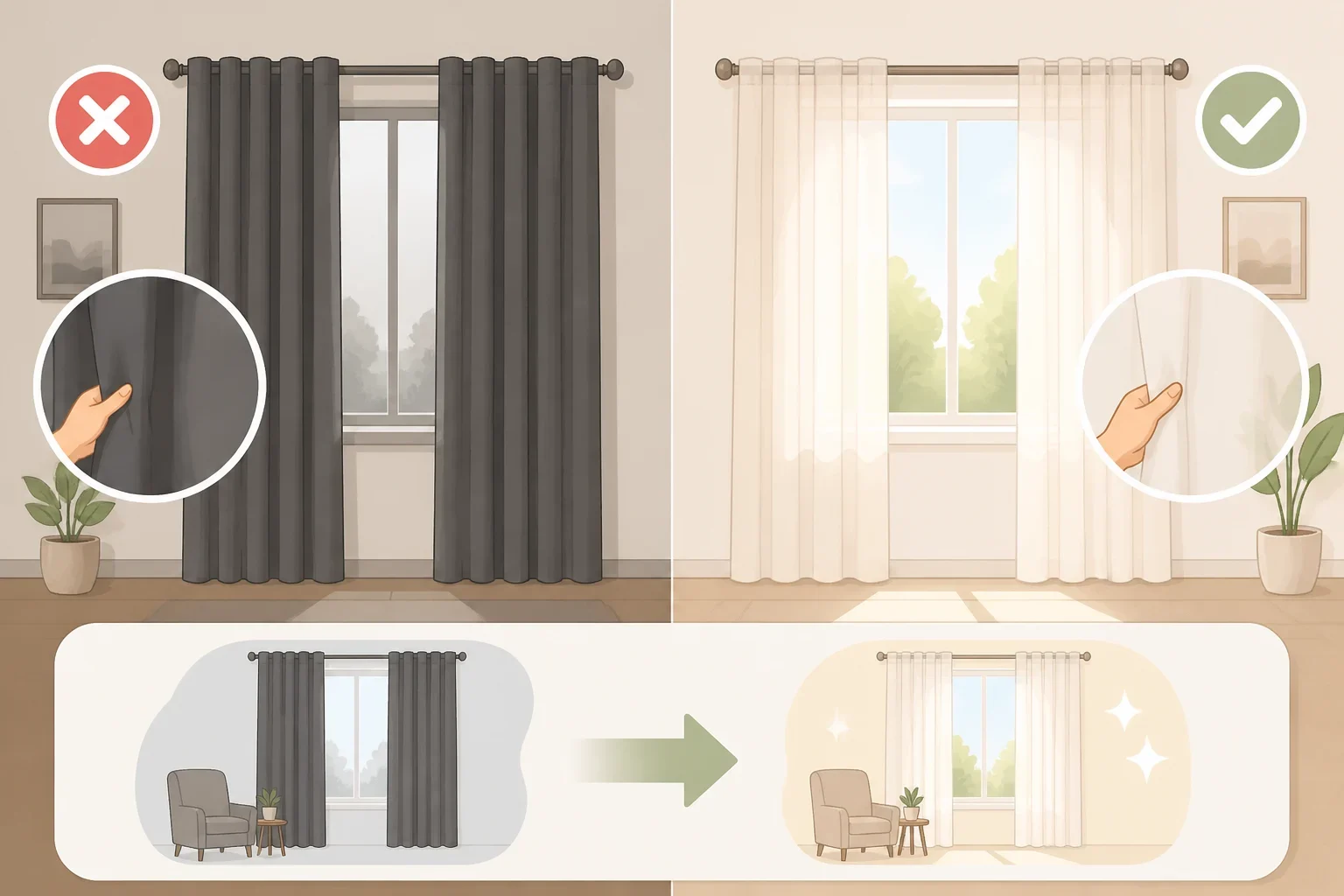
Light-colored curtains for dark rooms are a design choice, not a measured lighting solution in the supplied research. A pale solid, soft neutral, or low-contrast fabric can keep the window wall from feeling heavy, while a dark, dense pattern can draw visual weight toward the area that already feels dim.
Keep the goal in mind:
- For visual brightness, look for a lighter panel with a simple surface and enough width to open completely.
- For visual softness and privacy during the day, sheers may be useful, but they should not be treated as proof of nighttime insulation.
- For brightness and winter warmth, consider a lighter-colored lined panel. The lining adds weight and coverage without requiring a dark outer fabric.
- For homes with children, pets, or frequent cleaning, choose a hem that just kisses the floor rather than automatically opting for a puddle.
Magon recommends curtains that touch the floor or puddle slightly for a more dramatic look. A small puddle can also help close the gap at the bottom, but it is a style decision. Extra fabric on the floor may be less practical in a high-traffic room or around a vacuum, pet, or toddler.
When warmth matters, do not assume that the prettiest fabric will perform best. Consumer NZ’s testing found that heavy-lined curtains retained more heat than thermal-backed curtains, and that floor-length curtains retained more heat than sill-length curtains. The test used an aluminium-framed, single-glazed window, with conditions simulating a 4°C winter night while an electric heater maintained 20°C, so the result is useful for comparison but not a guarantee for every window.
Set up the daytime routine
The daytime goal is to expose as much of the window as possible.
Open the curtains in the morning and push each panel all the way toward the rod end. This is where the extra 8 to 12 inches of rod space earns its keep. If the stack still overlaps the glass, the rod may not be wide enough, the panels may be too bulky, or nearby walls and furniture may be limiting the opening.
Look at the room from the main seating position. The curtains should frame the window rather than create two dark blocks over it. If a pattern feels busy or the fabric makes the wall seem heavier, lighter solid panels may create a calmer visual field, even though the placement itself has not changed.
For a low ceiling, the raised rod and floor-length panels can draw the eye upward. The Spruce attributes that interpretation to Nina Magon and notes that the approach can work in rooms with low ceilings. Keep the installation proportionate, though. In a room with unusually high ceilings, a ready-made panel may fall short, and a valance or custom length may be needed to avoid a large unfinished gap.
Establish the nighttime warmth routine
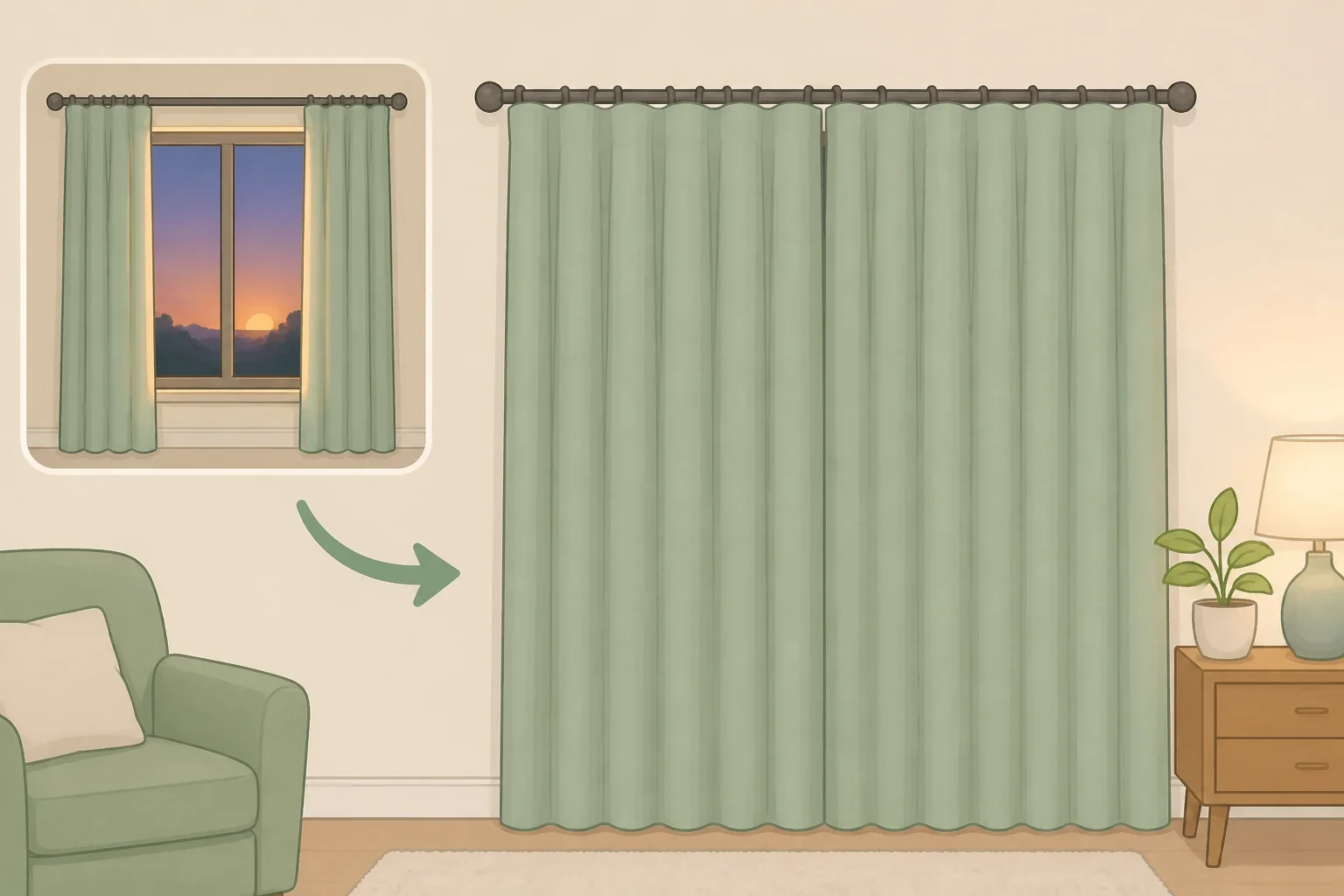
Close the curtains at sundown if keeping the room warm is part of the goal. Consumer NZ explains that a window covering creates an air pocket between the glass and the room, while gaps allow cold air to circulate.
For the best fit, closed curtains should:
- cover both sides of the window frame
- reach close to the top of the window area
- extend to the floor
- sit close enough to limit large gaps
- avoid being blocked by furniture or a heater
The visual and thermal goals overlap, but they are not identical. A rod that extends beyond the frame is useful during the day because the panels can move off the glass. At night, the important part is that the closed panels cover the frame and limit gaps.
Consumer NZ says 45% or more of heat loss in an insulated house can escape through windows, compared with 30% in a house without insulation. That figure comes from its testing information and applies to those home conditions, not every living room or climate. The same source reports that its curtain and blind results came from testing conducted in 2019.
The test found that honeycomb blinds retained more heat than the curtains tested. Consumer NZ also found that the secondary-glazing products it tested performed better than those curtains, although performance, cost, installation, and ease of use vary by product. The U.S. Department of Energy also provides information on interior cellular shades as an energy-performance option, but it does not establish a comparison with every curtain on the market.
If the room is cold because of drafts rather than simply dark, investigate those options instead of buying increasingly heavy curtains. Cellular shades, secondary glazing, or a glazing upgrade may address the physical problem more directly. A curtain makeover is the sensible first step when the complaint is visual darkness.
Use the simplest solution that fits the room
Start with the rod if the living room feels boxed in. Measure upward, extend the rod past the frame, and make sure the open panels clear the glass. Then choose enough width for 1.5 to two times the window measurement and enough length to reach the floor, adjusting for heaters, doors, children, pets, and cleaning needs.
Choose lighter panels when the room needs a softer, brighter appearance. Choose heavy-lined panels when winter warmth is also a priority, understanding that the available test results came from a specific single-glazed window and controlled conditions.
The decision is straightforward: if the problem is mainly visual, begin with curtain placement and lighter fabric. If the room is genuinely cold or drafty, keep the curtain plan, but also investigate honeycomb blinds, secondary glazing, or the window itself.
