
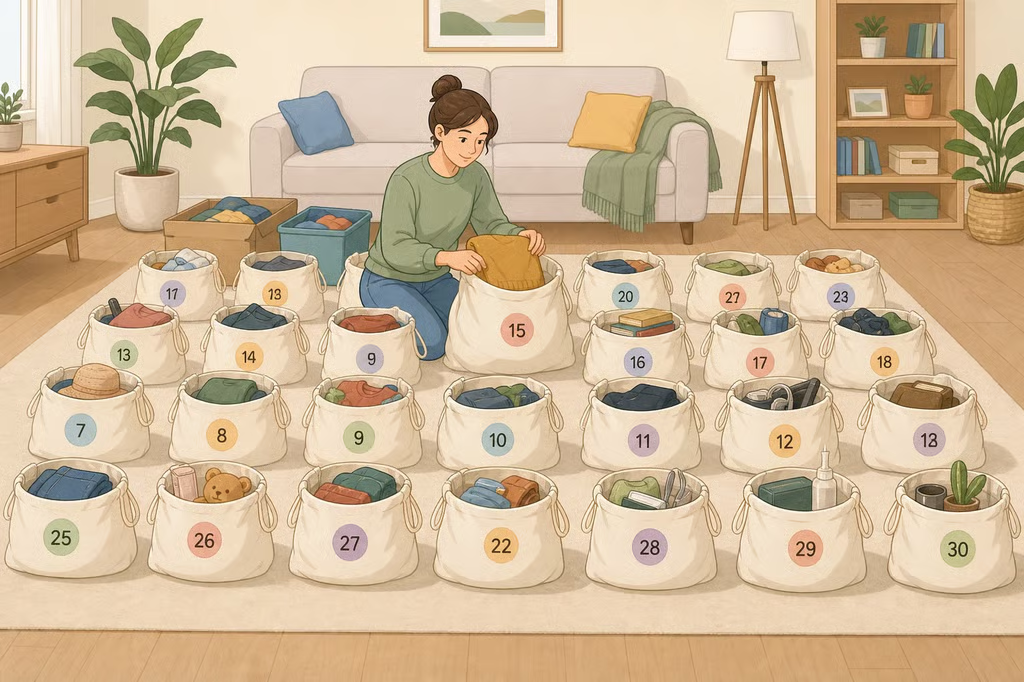
30 Bags in 30 Days Decluttering Challenge Without Burning Out
The 30 Bags in 30 Days decluttering challenge asks you to fill one bag with unwanted items each day for 30 days, then donate, recycle, or discard what you have sorted. A Good Housekeeping report from last year noted that the trend had passed 20 million TikTok posts at the time, but the number is less useful than the structure: one small decluttering session, repeated regularly. (Good Housekeeping)
That pace can be motivating, but it can also become one more daily obligation. The goal is not to force a full garbage bag out of the house every night. A smaller bag, a shorter session, or a slower schedule can still give you a workable way to declutter your home in 30 days without turning the project into a source of stress.
Choose your pace before you start
The standard format is straightforward: fill one bag of items you no longer need each day for 30 days. The bag can contain things for donation, recycling, sale, or disposal, but it should represent items leaving your household rather than belongings simply moving from one room to another. (Good Housekeeping)
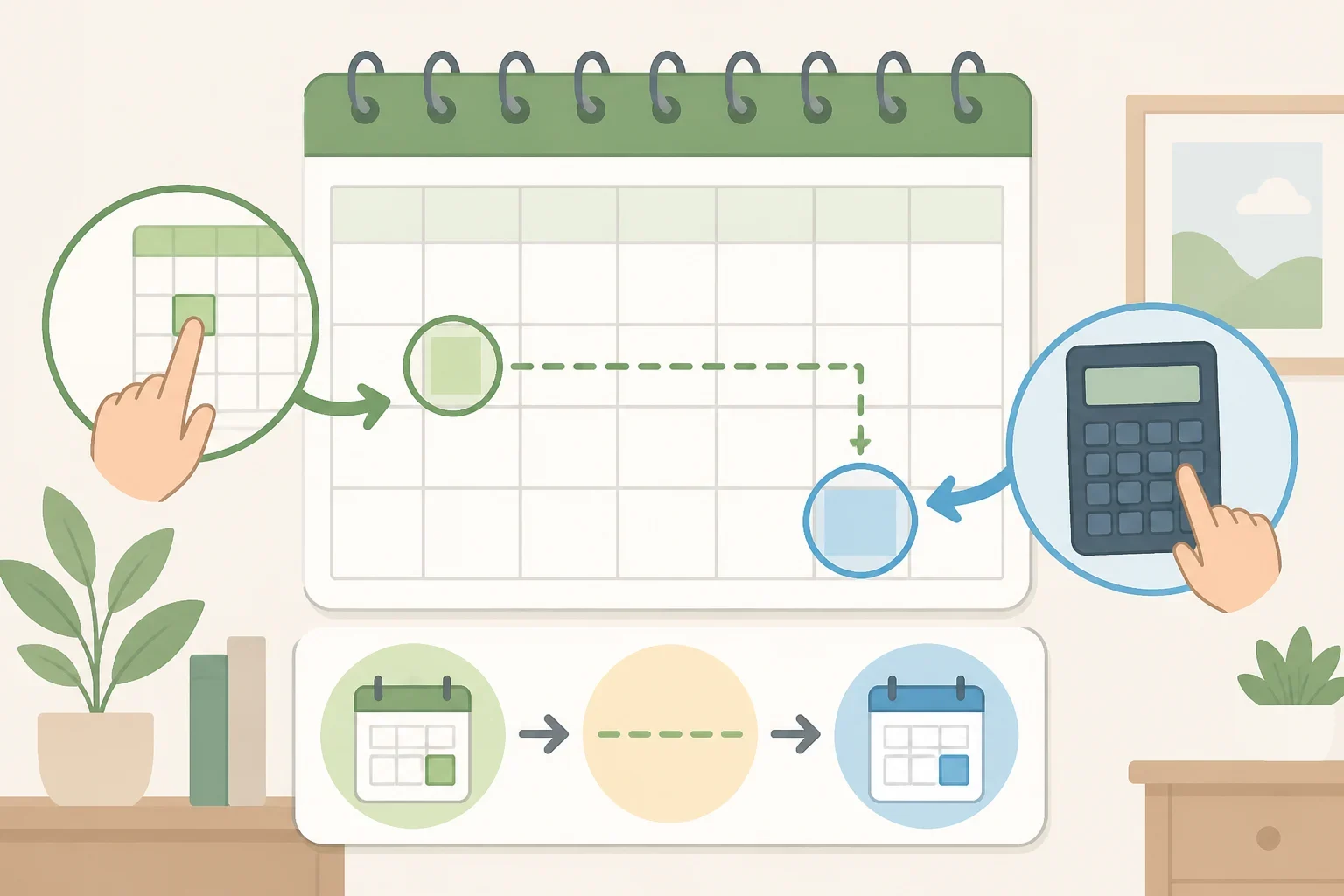
Before choosing a start date, look at the next month on the calendar. Count travel, work deadlines, family commitments, appointments, and weekends when the household will be busy. Then choose one of these approaches:
- Run the traditional challenge: Start on a day when you can reasonably give the project 30 consecutive days.
- Use 30 sessions instead of 30 consecutive days: Keep the one-bag-a-day structure, but allow yourself a pause when life gets crowded.
- Try one bag a week: Tonia Tomlin of Sorted Out recommends filling one bag every week for people who want a less demanding pace. She also suggests a “one in, one out” rule, meaning each new item brought into the home is paired with one item leaving it. (Good Housekeeping)
Choose the finish date now and write it on a calendar. If the traditional version begins on a Monday, the final session falls 30 days later in the same four-week stretch only when the calendar lines up that way, so check the dates rather than assuming. If you miss a day, resume the next day or move the finish date. Missing one session does not erase the work already done.
A related format, the 30-Day Minimalism Game, raises the number of items each day, from one item on day one to two on day two and so on. Items must leave the home through donation, sale, or disposal, and general rubbish or tiny bulk items do not count. A small Good Housekeeping UK staff trial reported nearly two years ago saw two of three participants stop on days 21 and 23, while one reached the end. That is a result from a three-person trial, not a prediction for every household, but it does show why a decluttering plan should fit the person using it. (Good Housekeeping UK)
Prepare your supplies and zones
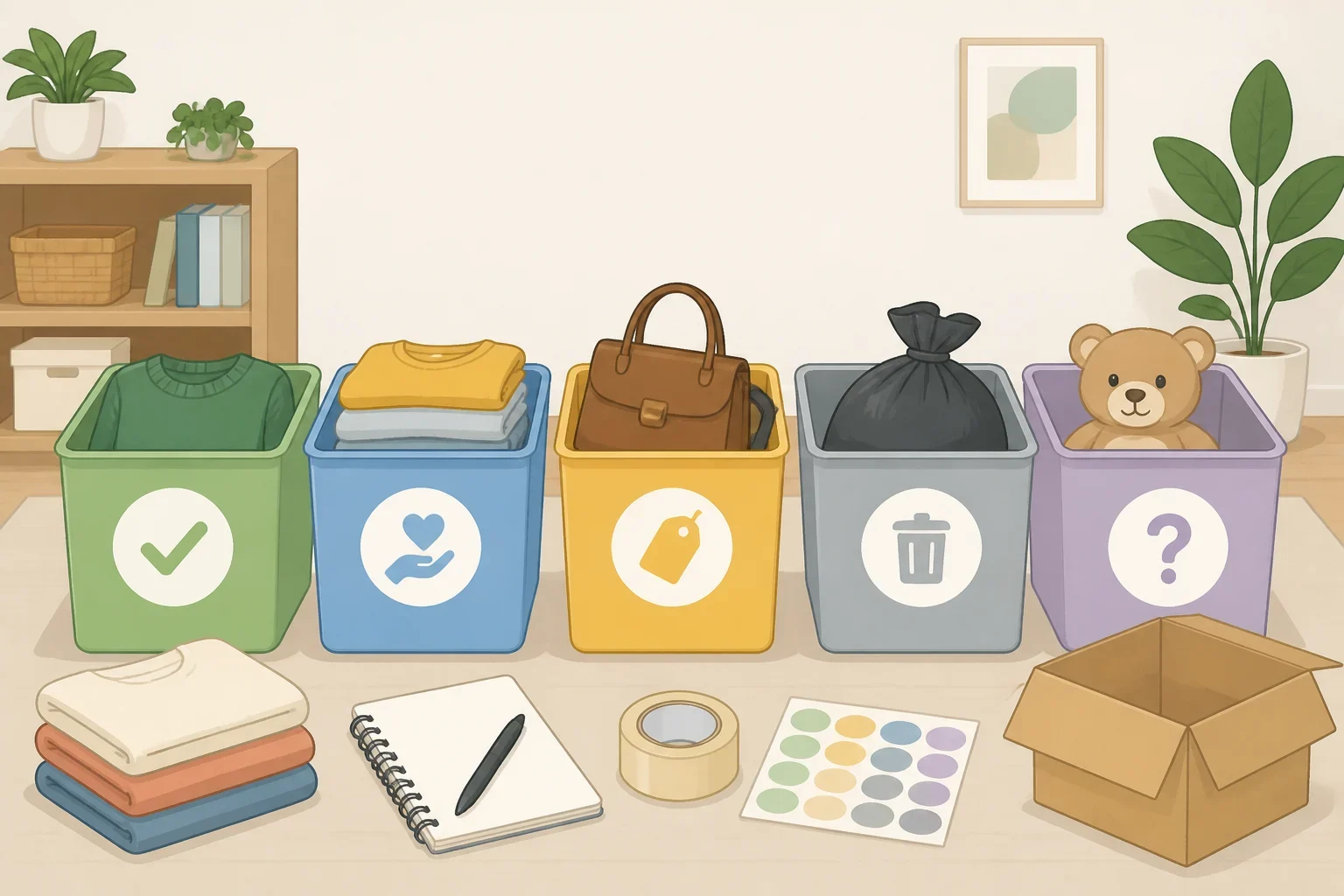
You do not need a special organizing kit. Set aside:
- A grocery-size bag or another container that feels manageable
- A box for items that need a later decision
- Labels or paper for “keep,” “donate,” “sell,” and “trash”
- A phone reminder or calendar
- A staging area away from the main living space
Schae Lewis of Mission 2 Organize LLC recommends a grocery-size bag rather than a large garbage bag. The smaller container gives you a clear limit and makes the daily task less intimidating. If your household has bulky items, use the same principle rather than cramming them into a bag. One item can be your day’s decluttering session even when it cannot fit in the container. (Good Housekeeping)
Victoria Tran of Sorted recommends setting a 15-minute timer. Stop when it rings, even if the room is not finished. The point is to create a repeatable session, not to empty an entire closet in one evening. (Good Housekeeping)
Next, walk through the home without removing anything. Make a list of likely clutter hotspots:
- A crowded kitchen cabinet
- The bathroom counter or medicine cabinet
- An entryway drop zone
- A linen closet
- A desk or paperwork drawer
- A children’s toy shelf
- A bedroom closet
Give each day a starting location before the challenge begins. This prevents the daily session from disappearing into indecision.
Choose a staging spot that is large enough to hold outgoing items but does not interfere with daily life. Lewis recommends keeping it away from the main living space when possible. A corner of a laundry room, a garage shelf, or a clearly marked area near the entry can work. Do not use a space that makes bags easy to forget.
If another person shares the home, agree on the staging area before beginning. A bag of someone else’s belongings should not be treated as yours to decide.
Start with low-emotion categories
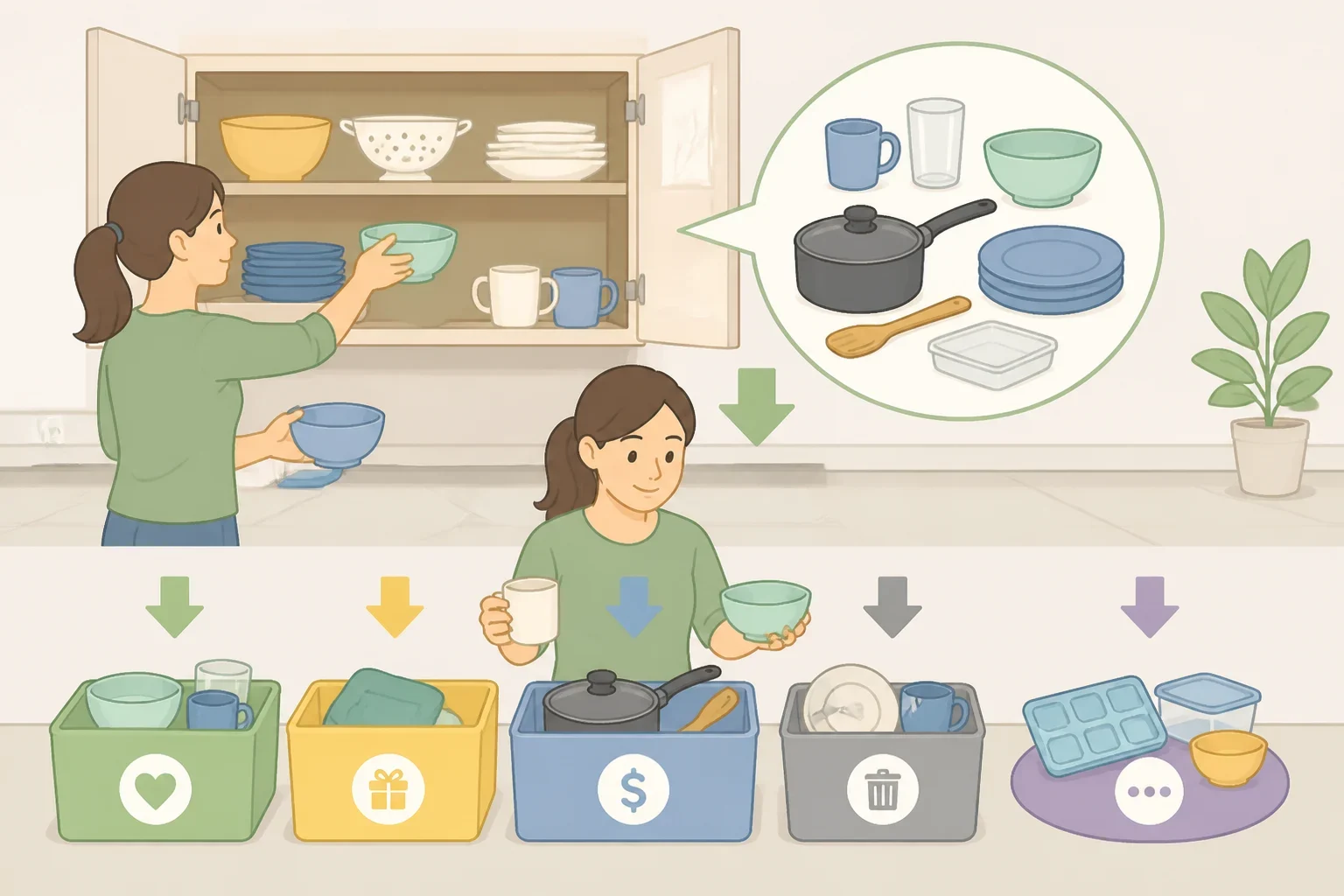
Reider recommends beginning with easy areas, such as expired items in the pantry or medicine cabinet. That is a practical starting suggestion, not a universal ranking of which categories are easiest. Choose a place where the decision is clear and the result will be visible.
Lindsay Melvin of Orchid Organizing suggests narrowing the assignment further, such as one cabinet of drinkware and coffee mugs or one category of medicines and first-aid items. A single category keeps the session from spreading across the entire room. (Good Housekeeping)
For each session, use this simple sequence:
- Open one drawer, shelf, or cabinet.
- Remove only the items that belong to that category.
- Place each item into keep, donate, sell, trash, or maybe.
- Put the keep items back before moving on.
- Close the session when the timer ends.
A category day might include duplicate mugs, worn-out linens, expired pantry items, old receipts, or cosmetics that are no longer used. In the separate Good Housekeeping UK Minimalism Game trial, one staff member reported removing 37 magazines, 46 documents and receipts, and 52 cosmetics. Another reached the end of the trial with 20 boxes of expired medicine. Those are individual results, not a typical household target. (Good Housekeeping UK)
When a bag is only partly full, leave it partly full. Do not add something you still use simply to meet a visual quota. The challenge is about removing unwanted items, not filling containers for their own sake. You can also combine two small sessions from the same category if that works better for your schedule.
Keep medicines separate from ordinary household rubbish while sorting them. Check local disposal guidance for expired or unwanted medicine before deciding how to remove it. Do not assume that every pharmacy, donation site, or recycling program accepts the same items.
Handle maybes and sentimental items slowly
The first week may feel easy because obvious clutter is easier to recognize. Lynda Reider of Cut the Clutter RVA says the harder stretch can arrive later, after the clear-cut items are gone and sentimental decisions remain. (Good Housekeeping)
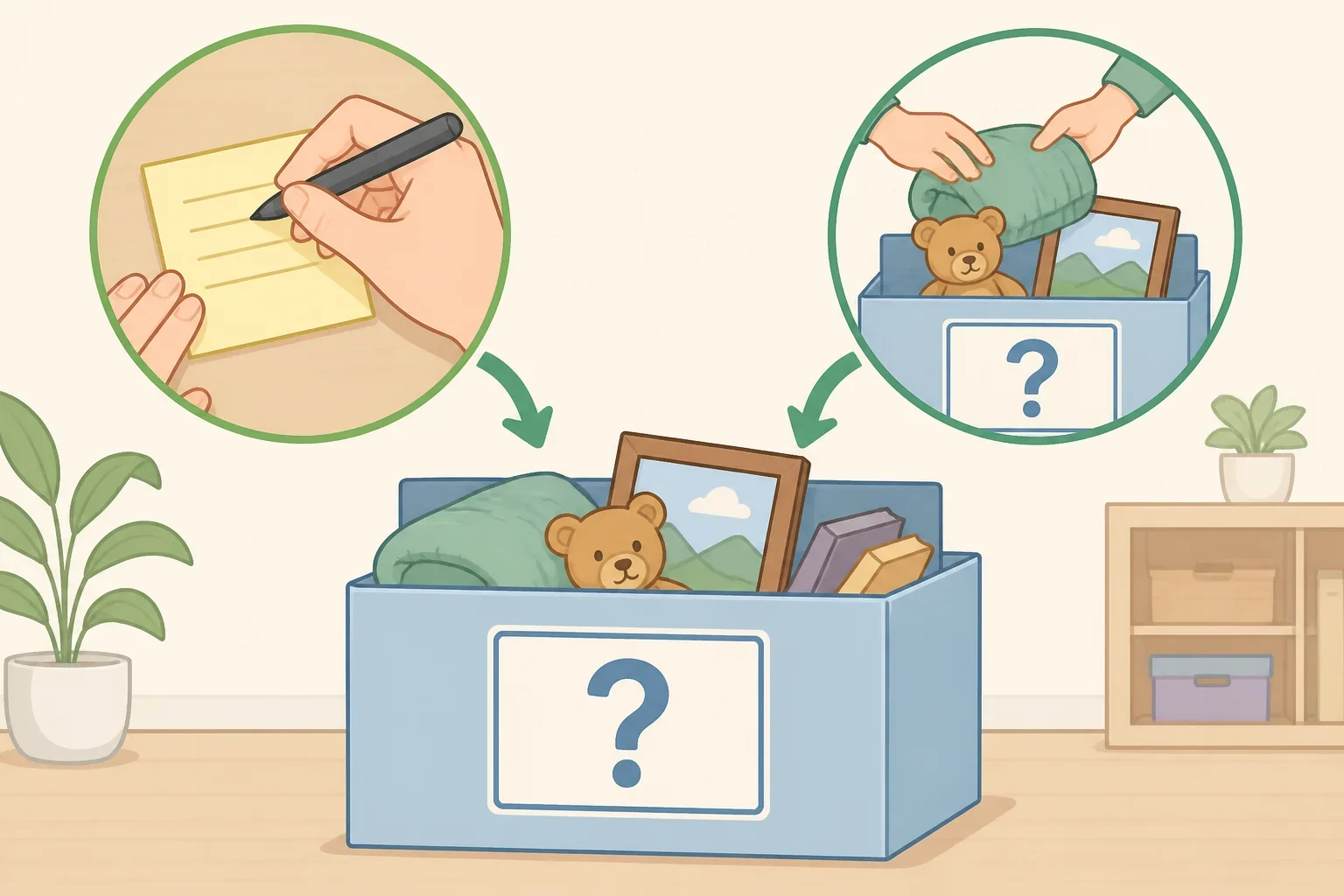
Do not force a sentimental decision just to keep the streak alive. Put uncertain items in a labeled box and write a reminder for a future date. Tran recommends this “maybe box” approach for belongings you are not ready to release. If you have not needed the items when the reminder arrives, the decision may feel clearer. (Good Housekeeping)
A partner or family member may have a different definition of unnecessary. Keep these rules in place:
- Sort your own belongings without asking someone else to defend them.
- Ask before touching shared items.
- Let the owner make the final decision about sentimental belongings.
- Agree on shared categories, such as duplicate kitchen tools or damaged linens.
- Use a neutral question: “Do you want to keep this, decide later, or let it go?”
- Set a short, separate session for shared spaces so one person does not become the household’s decluttering manager.
For children, offer a small number of choices rather than asking them to empty an entire room. The point is to make decisions together, not create a cleanup battle. If a family member does not want to participate, continue with personal belongings and shared areas that have already been discussed.
Remove the bags safely and promptly
Sort each outgoing bag before it leaves the staging area. “Donate” should contain items in usable condition. “Sell” should be limited to belongings worth the time and effort of listing, photographing, communicating, and arranging pickup or shipping. Set a personal deadline for listings so they do not become a permanent second staging pile.
For items that cannot be donated or sold, follow the disposal or recycling rules in your area. Some materials require separate handling, and not every item belongs in ordinary trash. When in doubt, check the relevant local program before putting it in a bag.
The 30 Bags challenge does not require every bag to be removed on the same day, but prompt removal keeps the staging area from becoming a new clutter zone. Schedule a donation drop-off, recycling trip, sale pickup, or disposal task before the bag reaches the hallway or garage. The Minimalism Game uses removal from the home as part of its format, and that distinction is useful here too: a bag is not finished merely because it has changed rooms. (Good Housekeeping UK)
Maintain the result after the final session
The last day should not be the end of the system. Walk through the areas you worked on and notice which categories filled up fastest. That information can guide a simple household rule, such as keeping fewer backups in one cabinet or checking the pantry before shopping.
Research published earlier this year interviewed 15 professional tidying consultants in Japan. The participants described keeping fewer unnecessary stocks, using what they already owned, and maintaining items so they lasted longer after tidying. The study also found that broader environmentally friendly habits, such as saving energy or buying secondhand goods, were weakly connected to tidying and depended largely on personal values. (Journal of Sustainability Research)
That study should not be read as proof that a 30-day decluttering challenge will create the same results. Its participants were professional consultants who had already successfully tidied their own homes, and the sample was limited and not representative of households generally. The useful lesson is narrower: clearing space can be paired with a few deliberate consumption habits, but it does not automatically create them.
For the next month, keep the maintenance simple:
- Use the “one in, one out” rule if it suits your household.
- Keep a small donation container in an agreed location.
- Review one clutter hotspot during a regular household reset.
- Finish the outgoing bags instead of allowing them to accumulate.
- Leave sentimental decisions for a separate, calmer conversation.
The best version of this one bag a day decluttering challenge is the one that fits your schedule and energy. Choose a bag size, select a starting hotspot, set the first 15-minute session, and decide where outgoing items will go before you begin. A smaller plan that reaches the finish line is more useful than a rigid challenge that leaves half-sorted bags behind.
