
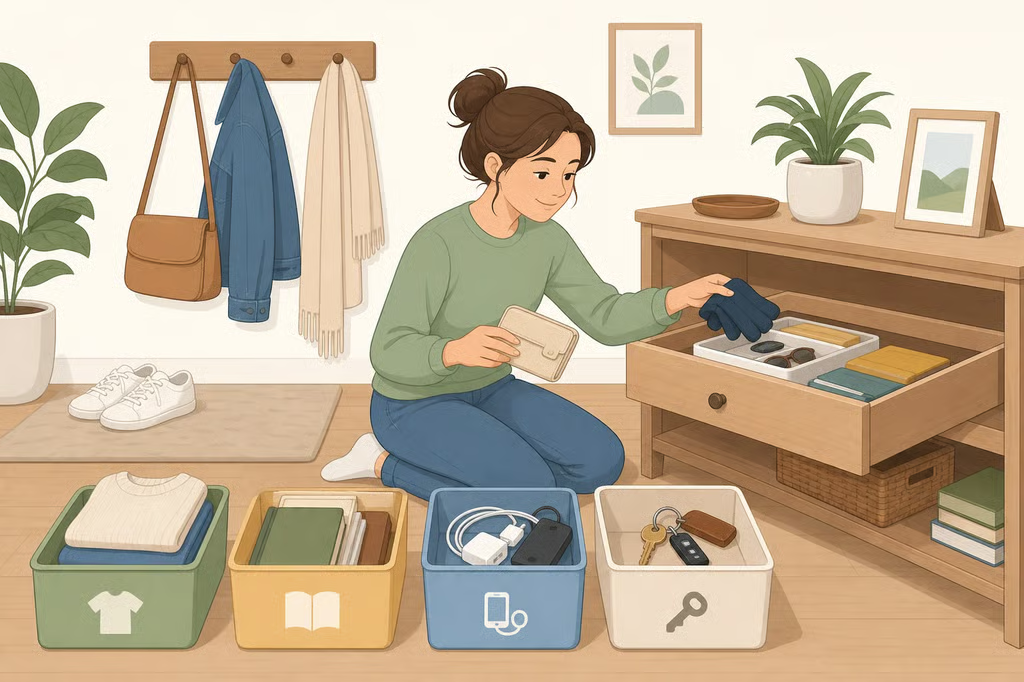
- How to Prevent Clutter in Your Home: 5 Habits
- 1. Choose one small zone and finish it
- 2. Sort what stays, what leaves, and what needs more time
- 3. Assign access levels based on how often you use things
- 4. Make the correct home obvious and easy to use
- 5. Stop paper and mail clutter at the door
- Build a maintenance loop that fits real life
How to Prevent Clutter in Your Home: 5 Habits
Buying bins before sorting can add containers without reducing the number of belongings in your home. Professional organizer Drew Price told Consumer Reports in January that he sees many people buy organizing products before deciding what to keep, which wastes time and money.
A better approach to how to prevent clutter in your home is straightforward: reduce the volume first, give the remaining items practical homes, then maintain those homes with small resets. The process below is meant for everyday household clutter, not a substitute for professional organizing support when disorganization feels unmanageable or connected to a larger emotional or logistical issue.
1. Choose one small zone and finish it
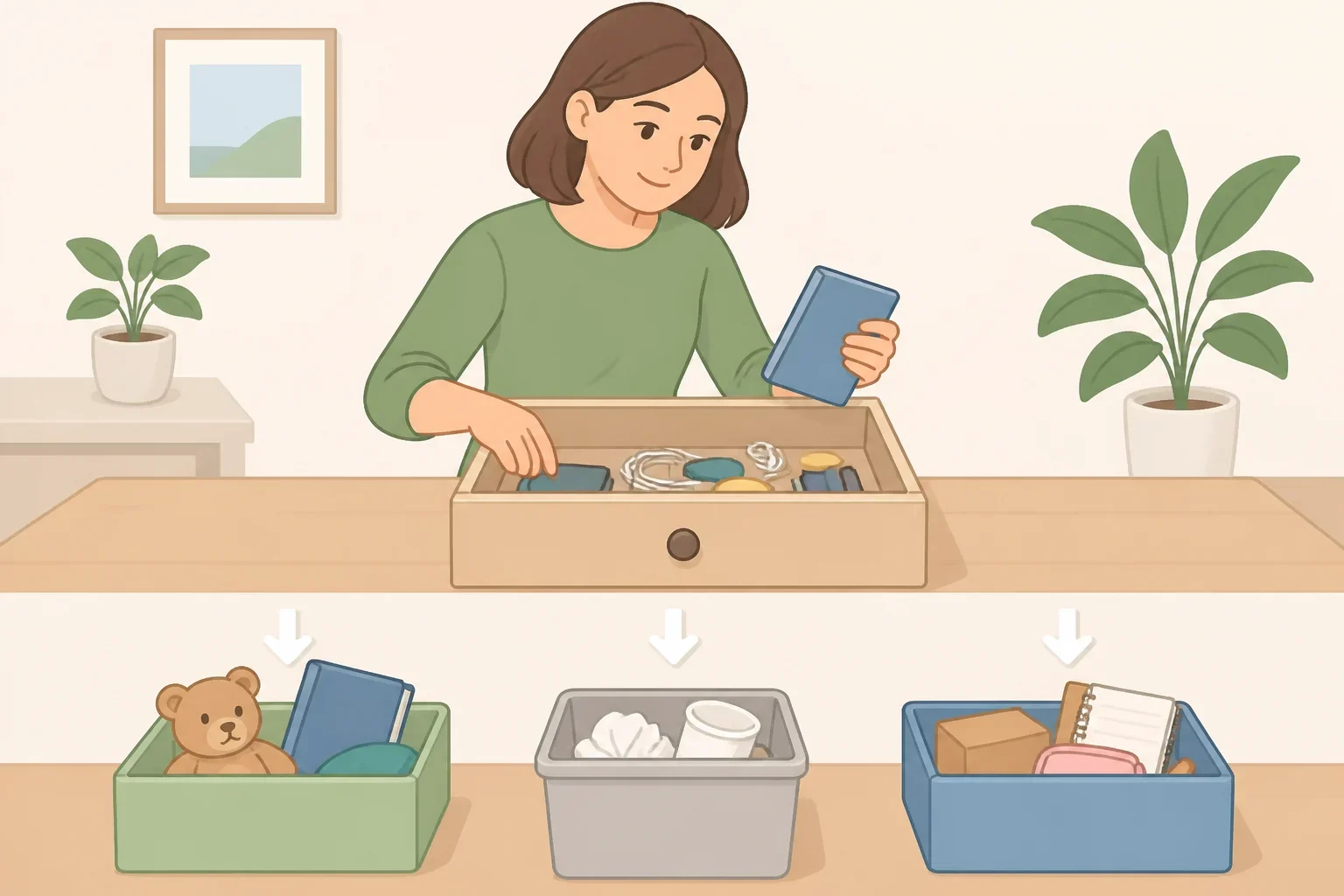
Start with the smallest space that causes regular friction. That might be one kitchen drawer, one closet shelf, the entryway table, or the spot where bags and shoes collect. Do not begin with the entire garage, basement, or a room filled with sentimental belongings.
Consumer Reports’ decluttering guidance recommends choosing a task with a high chance of success, such as one drawer or shelf, instead of tackling a large area or family heirlooms first. A contained project gives the household a clear finish line and makes it easier to see what changed.
Before you begin, gather:
- A trash bag or box
- A container for donations or items to sell
- A small box for things that belong elsewhere
- A temporary container for undecided items
- A cloth or cleaning supplies, if the space needs wiping after it is empty
Work on the floor, a cleared table, or another surface large enough to see the entire group of belongings. Remove everything from the chosen zone rather than making decisions one object at a time while the rest stays hidden. Seeing the full volume makes duplicates and forgotten items easier to spot.
Set a stopping point before you start. Organizer Nicole Mahmood told Consumer Reports that organizing an entire house in one day is unrealistic if the work is done properly. She advises working in two- to four-hour blocks, at a time when energy is higher, to help prevent burnout and rushed decisions. If the zone is not finished when the block ends, stop at a natural point and leave the outgoing items clearly separated.
The goal is not to make the whole home perfect in one weekend. It is to complete one useful area well enough that putting things away becomes easier.
2. Sort what stays, what leaves, and what needs more time
Once the zone is empty, sort each item into a simple decision category. Keep the choices visible and practical:
- Keep here: Items that belong in this zone and are used often enough to justify the space.
- Move: Items that belong somewhere else in the home.
- Sell or donate: Usable items that no longer earn their space.
- Recycle or dispose: Broken, expired, damaged, or unwanted items that cannot reasonably be passed on.
- Decide later: Items that need a little more thought.
Remove obvious trash first. That quick win is also consistent with Consumer Reports’ decluttering guidance, which recommends getting rid of trash before moving into more complicated decisions.
Use the undecided category carefully. It is a pause, not a permanent storage system. Put those items in a dated box, write a short description on the outside, and place the box somewhere that does not interfere with daily life. Set a future review date. If opening the box brings the same uncertainty, ask whether the item serves a current need or whether it is being kept only for a hypothetical future scenario.
Do not let outgoing items remain in the newly organized zone. Choose the next action before moving on:
- List an item for sale.
- Put donations in the car or by the door for the next drop-off.
- Check the appropriate local process for recycling or disposal.
- Separate hazardous materials rather than placing them in ordinary household trash.
Consumer Reports recommends three general paths for unwanted possessions: sell, donate, or dispose. Its guidance also points readers toward Earth911 for household hazardous-waste programs and the Environmental Protection Agency’s Responsible Appliance Disposal program for groups that collect and recycle refrigerated appliances such as refrigerators, freezers, and window air-conditioning units.
This step is where clutter prevention begins. If an item leaves the home promptly, it cannot drift back onto the floor, into a spare room, or into a new storage bin.
3. Assign access levels based on how often you use things
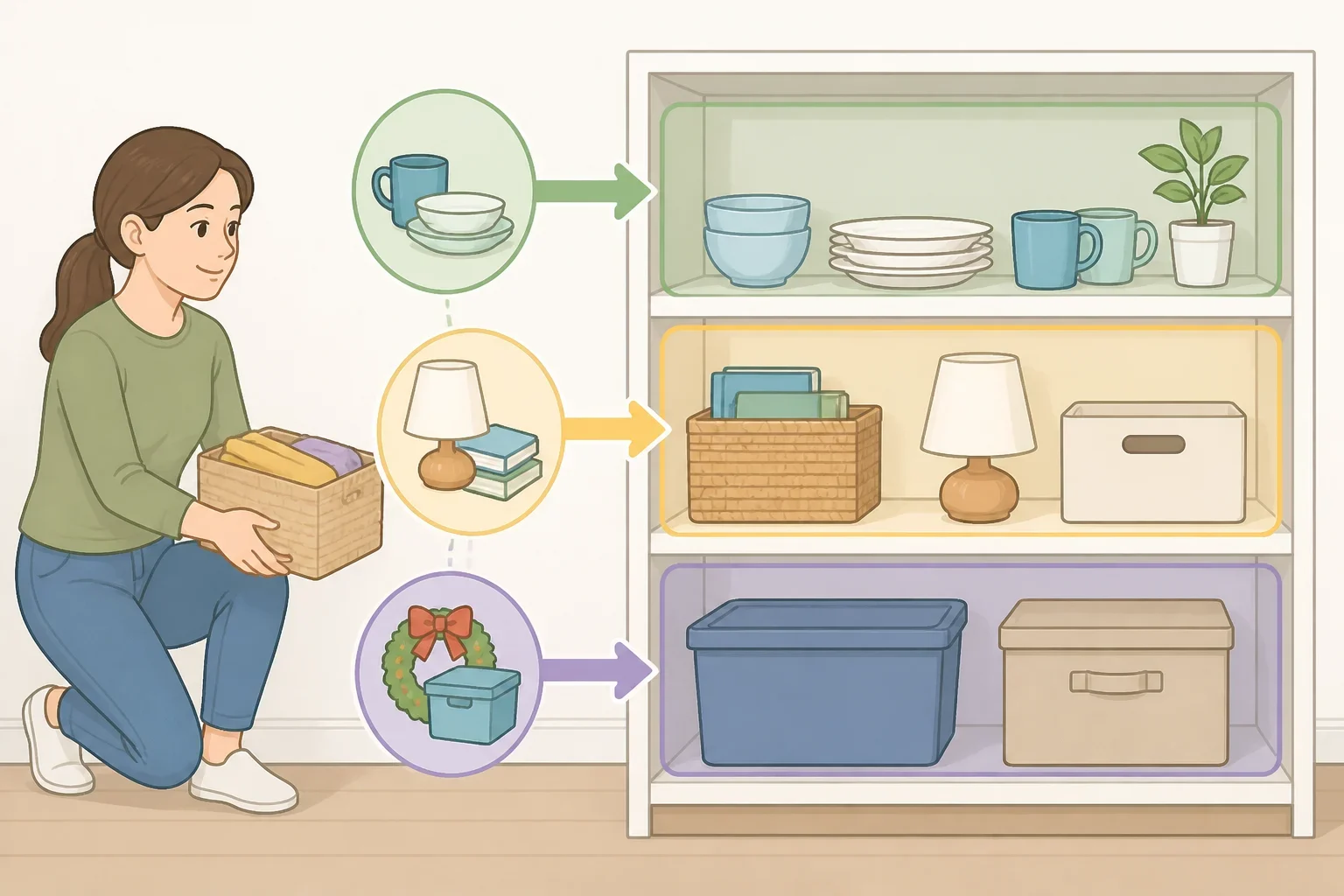
After the keep pile is smaller, decide where each item should live according to frequency of use. Elese Denis uses a three-part system, described in Consumer Reports:
- Everyday items: Keep these within easy reach. Flatware, plates, cups, and other daily essentials should not require a ladder or a deep search.
- Occasional items: Place these in less accessible locations. A roasting pan used for holidays or special occasions can go on a higher shelf.
- Rarely used items: Store these in labeled bins or boxes out of sight. Examples include a bread maker or extra stand-mixer attachments used only once or twice a year.
The colors in Denis’s system, yellow for everyday items, blue for occasional items, and red for rarely used items, are her organizing method, not an objective standard. The useful principle is matching access to actual use.
Test each storage location before calling the zone finished. Take out the items you reach for most, then return them. If the movement feels awkward, the location is too far away, too high, or too crowded. A storage spot is not practical simply because an item fits there. It needs to be easy enough for everyone who uses the space to put the item back.
Vertical storage can be especially useful in a garage. Organizer Tanisha Lyons-Porter told Consumer Reports that when garage storage is not used vertically, belongings spread across the floor and can eventually require storage elsewhere in the house. Cabinets, shelves, and freestanding racks can reclaim that floor space.
Keep daily-use items at a comfortable height, though. Putting frequently grabbed objects on a high shelf may technically use vertical space, but it can create enough inconvenience that those objects end up on the nearest counter or floor. Reserve harder-to-reach areas for occasional and rarely used belongings.
4. Make the correct home obvious and easy to use
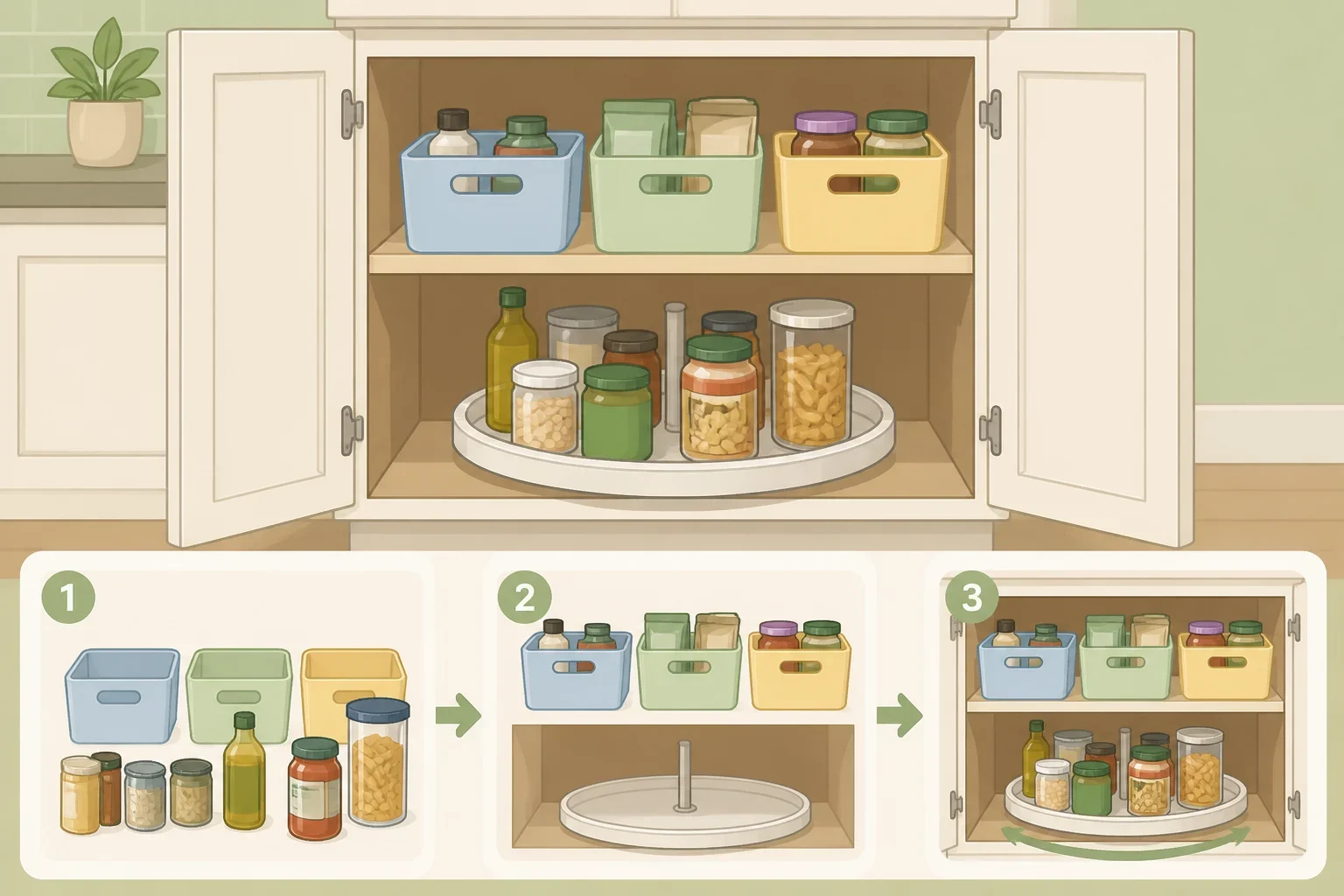
A household system works only when people can understand it and use it without a scavenger hunt. Give each group a clear home, then reduce the effort required to return items there.
Labels can help household members identify where an item belongs. Organizer Joby Aranda told Consumer Reports that labeled containers provide accountability by showing both where items are found and where they should go back. Labels do not guarantee that everyone will put things away, but they remove one common point of confusion.
Use labels that describe the category plainly. “Batteries,” “winter accessories,” or “extra toiletries” is more useful than a vague label such as “miscellaneous.” If a container holds several unrelated categories, the container may be too broad to support an easy return routine.
Clear bins are one option when seeing the contents prevents forgotten items. Organizer Rachel Rosenthal prefers clear pantry bins and uses them in spaces including linen closets and bathrooms. They can help create categories and show what is inside, but they are not required for every area. A label on an opaque container can work just as well when the contents are stable.
For deep cabinets, designer Jeffrey Phillip recommends turntables, also called lazy Susans, to improve access to frequently used items and prevent belongings from disappearing at the back. Use one when reaching around or moving several objects is the reason items are being left out.
Renters and households with limited space can also consider storage that uses an existing door or wall without installing permanent shelving. Sharon Lowenheim recommends Command hooks for uses such as hanging pans or managing cords, while professional organizer Maria Sanchez uses an Elfa over-the-door rack in areas including a hallway closet. Follow the product’s weight limits and surface instructions, since an adhesive hook or rack is not automatically suitable for every wall, door, or item.
Before buying anything, check the built-in storage already available in the home. A shelf, cabinet, drawer, or closet may solve the problem once excess items are removed. If new storage is still needed, measure the space and the remaining belongings first. The goal is to fit storage to the items, not to find items for storage.
5. Stop paper and mail clutter at the door
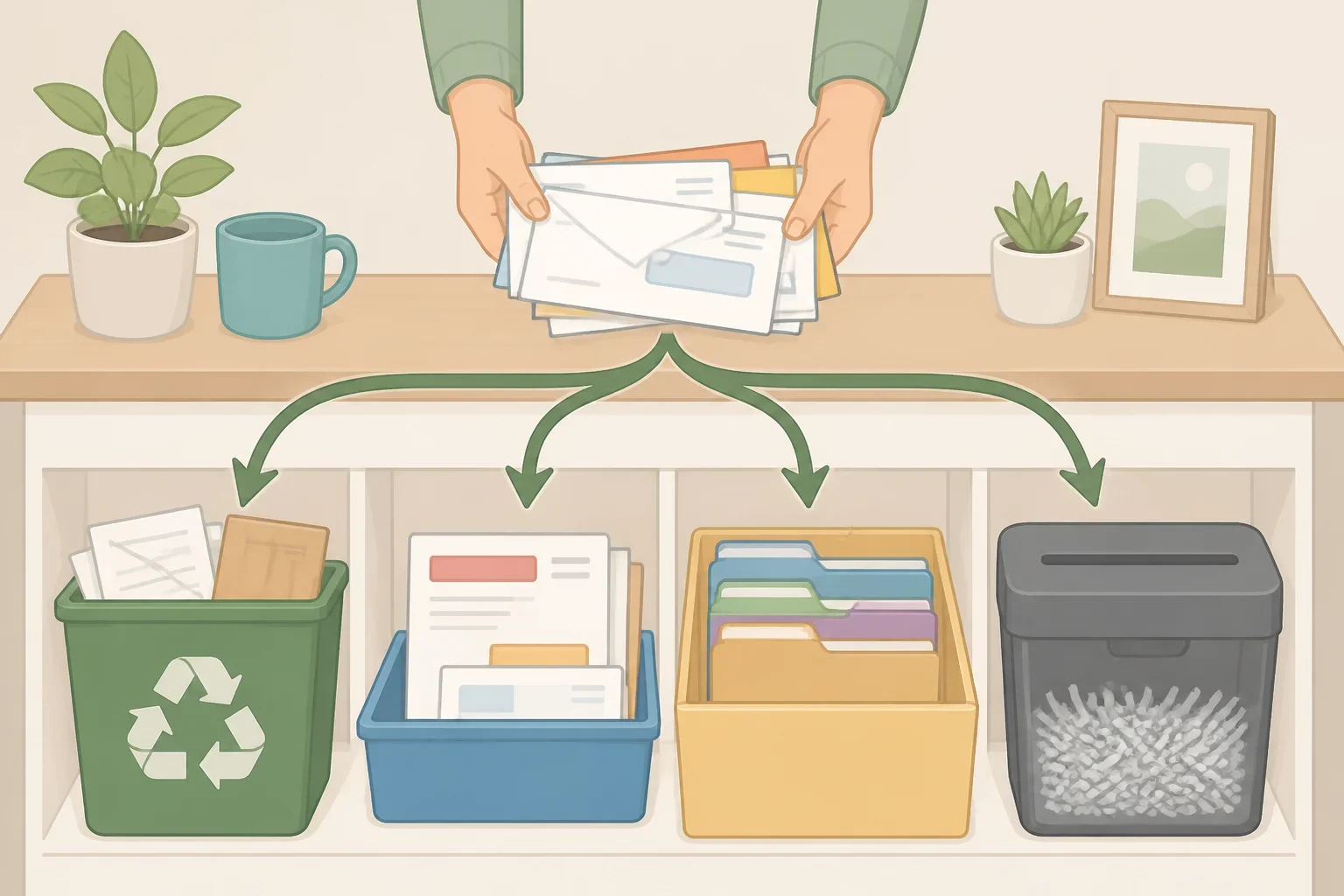
Paper is a steady source of incoming clutter, so handle it before it becomes a stack. Productivity specialist Pamela Mims told Consumer Reports that opening mail the same day, near a recycling bin, makes it easier to discard unwanted inserts, solicitations, donation requests, and credit card offers immediately.
That does not mean every document should be thrown away. Separate mail into a few clear destinations:
- Recycle or discard material that has no lasting use.
- Place bills and action items where they will be handled.
- File documents that need to be kept.
- Shred outdated papers containing sensitive personal or financial information, after checking whether any retention requirement applies.
Colorado State University Extension reported last year that a systematic plan for important documents can reduce nonessential paper clutter and save hours of anxious searching. Its guidance also recommends regular filing and review regardless of whether records are stored in paper or electronic form.
Keep hard-to-replace documents in a safe-deposit box or a fireproof, waterproof, burglar-proof home safe or lock box, as appropriate for the document and the storage option. Do not assume every household safe offers the same protection. Electronic records need to remain legible, readable, and accessible for the required period, and electronic files should be backed up in case of computer failure.
A simple paper station can be enough: one clearly labeled place for action items, one place for documents to file, and a shredder or secure disposal plan for outdated sensitive papers. Review the station during a short weekly reset so papers do not quietly migrate to the kitchen counter.
Build a maintenance loop that fits real life
A practical prevention routine does not need to be elaborate. Once a week, set a timer for five minutes and walk through the main clutter points. Return items to their homes, carry outgoing items to the door or car, and clear any obvious trash or recycling.
This is editorial advice rather than a sourced rule, so adjust the timing to the household. The useful sequence is return, remove, and review. If an item repeatedly lands in the same wrong place, treat that as information. Its assigned home may be too far away, too difficult to access, or unclear to the people who use it.
Use the longer review for stored belongings. Denis recommends looking through stored bins and boxes after six months to a year, when it may be easier to recognize what has not been used. Add that review to a calendar rather than waiting for another large organizing project.
When clutter creates severe tripping or fire risks, strains floors, or allows damp items to encourage mold and mildew, deal with the safety issue first. Consumer Reports has also noted that clutter can contribute to misplaced bills or medications. If the volume feels impossible to manage alone, professional help is a valid next step. Consumer Reports cited a typical service range of $251 to $812 for professional organizing, with cost varying by location and scope.
Choose one small zone today. Remove trash and outgoing items, sort what remains by use, and test whether each item’s home is easy to reach and easy to explain. Do not buy a container until the final volume is clear. That one decision puts the home on a steadier path toward staying organized.
