
September home organization tips: 11 fall-ready checklists
September home organization tips do not need to begin with a whole-house purge. Start with three places that affect nearly every day: clear the walking paths, create one drop zone near the door, and reset one surface the household uses constantly. Those small changes can make it easier to move through the morning without buying new furniture or spending an entire weekend sorting possessions.
This list shows how to organize your home in September through 11 manageable resets. The suggestions work for renters, couples, families with young children, and households with older adults. Each one has a clear stopping point, so the project does not quietly become a second job.
Start with the areas that create friction
The research behind these September decluttering tips connects household disorder with stress, mood, family outcomes, and falls. It does not prove that decluttering directly improves productivity, and none of the steps below should be treated as a guaranteed mood or routine fix.
A 2010 study asked 60 married couples to give researchers tours of their homes, then examined the language they used about clutter and unfinished projects before measuring cortisol patterns over the following three days. Women who described more clutter and unfinishedness had flatter daily cortisol slopes and experienced increases in depressed mood over the day. The study was correlational, so it showed an association rather than proving that clutter caused those outcomes, as a research summary published two weeks ago explains.
A separate experiment placed 96 young women in either a calm or deliberately chaotic living room while they cared for an infant simulator. The chaotic room included crowding, clutter, and sensory stimulation, and participants had higher levels of salivary alpha-amylase, a physiological stress marker. That finding supports treating an overstimulating room as a practical household problem, not as evidence that every untidy room causes stress.
With that limit in mind, begin here.
September home organization tips to try first
1. Clear the main walking paths
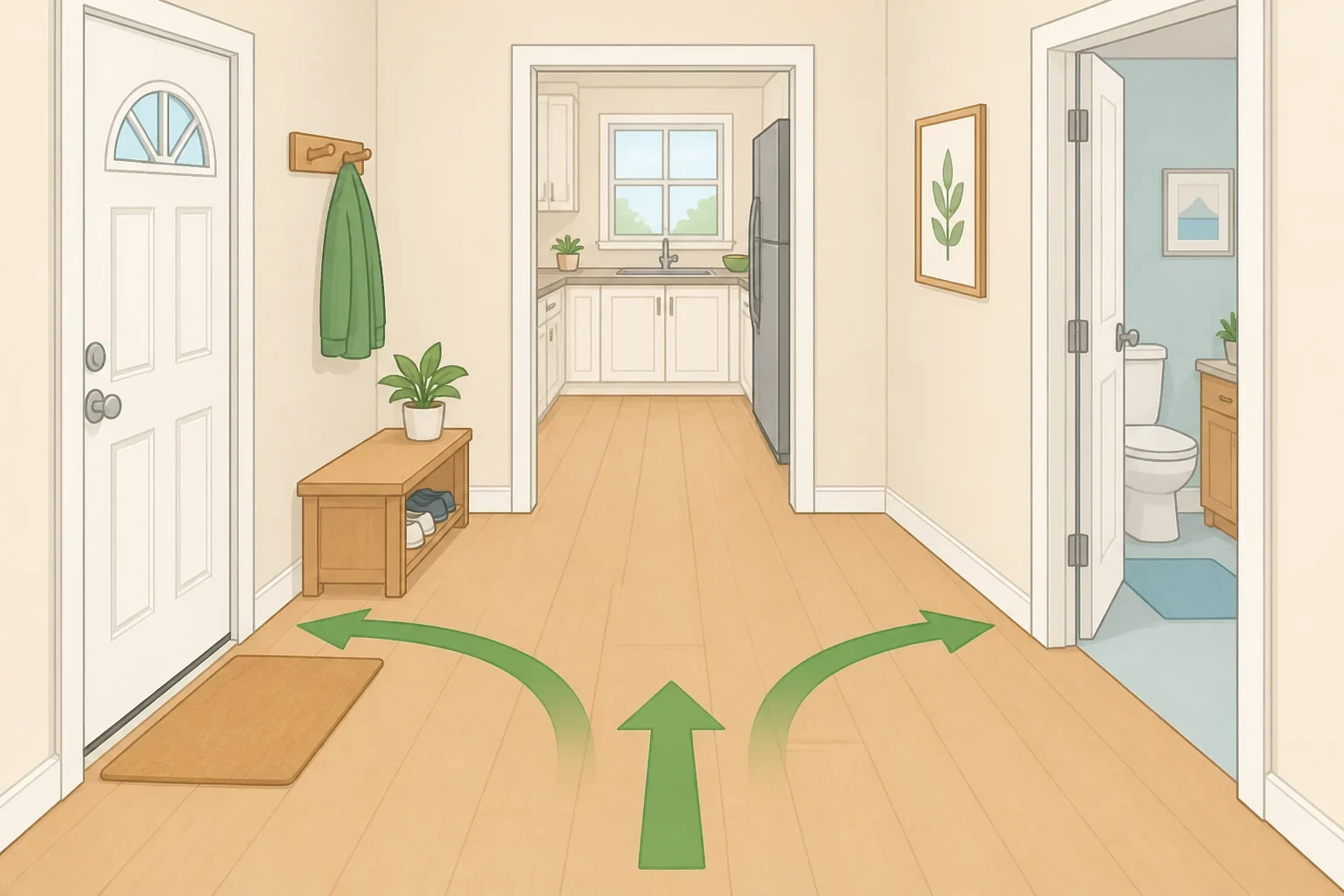
Walk from the front door to the bathroom and kitchen. Remove shoes, bags, toys, boxes, cords, and anything else that makes someone step around an obstacle. In a home with an older adult, look especially closely at the path used at night. In a home with young children, check the floor at their eye level too, since small toys can be easy for adults to miss.
Renters do not need to change the flooring or install permanent storage. Use one existing basket for loose items, or move them temporarily to a clearly chosen holding spot. Stop when the paths are open and easy to walk without turning the task into a full-room sort.
This is the one reset to prioritize when safety is a concern. A study of 2,599 community-dwelling Medicare beneficiaries age 65 and older examined home disorder, including tripping hazards and room clutter, against falls the following year. Home disorder was associated with subsequent falls even after other factors were considered, according to the research summary. The finding does not prove that clearing a particular floor prevents a fall, but it makes a path check a sensible safety task.
2. Create one drop zone by the door
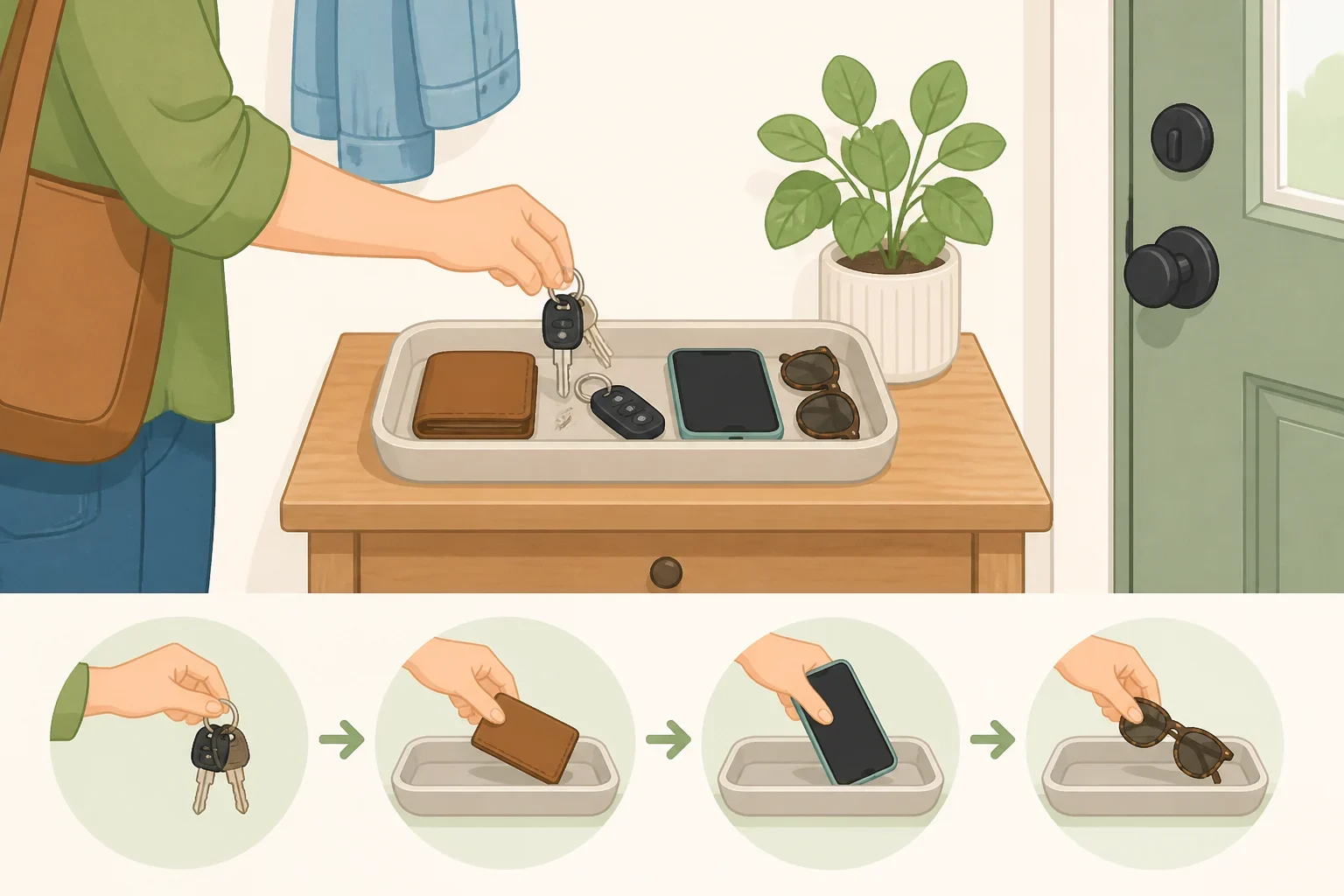
Choose the first place people naturally set things down. Add a small table, a basket, a tray, or a renter-approved wall hook for keys, bags, shoes, mail, and anything that needs to leave the house.
Keep the system intentionally small. One basket can hold items headed elsewhere, while a tray can collect keys and incoming mail. If the entryway is narrow, designate a spot just inside the home rather than blocking the doorway. For a couple sharing the space, make sure both people can reach the drop zone without moving the other person’s belongings.
The reset is finished when everyone knows where the everyday items go. Do not add labels or purchase a storage unit yet. First see whether the chosen spot works with the household’s actual traffic pattern.
3. Close out one stalled project
Choose one unfinished task that keeps occupying visual or mental space. It might be a stack of paperwork, a donation bag, a loose cabinet handle, or a half-finished repair. Either complete the next realistic action or decide that the project is no longer worth keeping open.
Be specific. “Deal with paperwork” is too broad, while “recycle the expired notices and place the two forms that need action in the paper tray” gives the task an end. If a repair needs a professional, write down that next step rather than leaving the item in a permanent state of suspense.
The 2010 home-tour study included language about both clutter and unfinished projects, but it did not test whether finishing a project has the same effect as removing objects. Treat closing one loop as a practical experiment, not a research-backed cure. Stop after one project.
4. Test a 15-minute reset
Set a timer for 15 minutes and choose one contained area, such as the coffee table, one kitchen drawer, or the floor beside the sofa. Sort items into three destinations: put away, recycle or discard, and decide later. When the timer ends, stop or take a short break.
A short session is a scheduling choice, not a proven intervention. It can fit more easily into a busy week than an all-day purge, and the source behind the research discussion suggests a 15-minute playlist session as a motivational starting point. The research summary does not establish that this method is more sustainable than any other.
The stopping point matters. Do not pull open a second drawer because the first one went well. The aim is to finish one visible reset and leave enough energy for ordinary life.
Fall home organization checklist for shared spaces
Once the floors are safe, make the surfaces people use most often easier to use. Shared spaces do not have to look spare. They need enough open room for the next activity.
5. Reset one highly visible surface
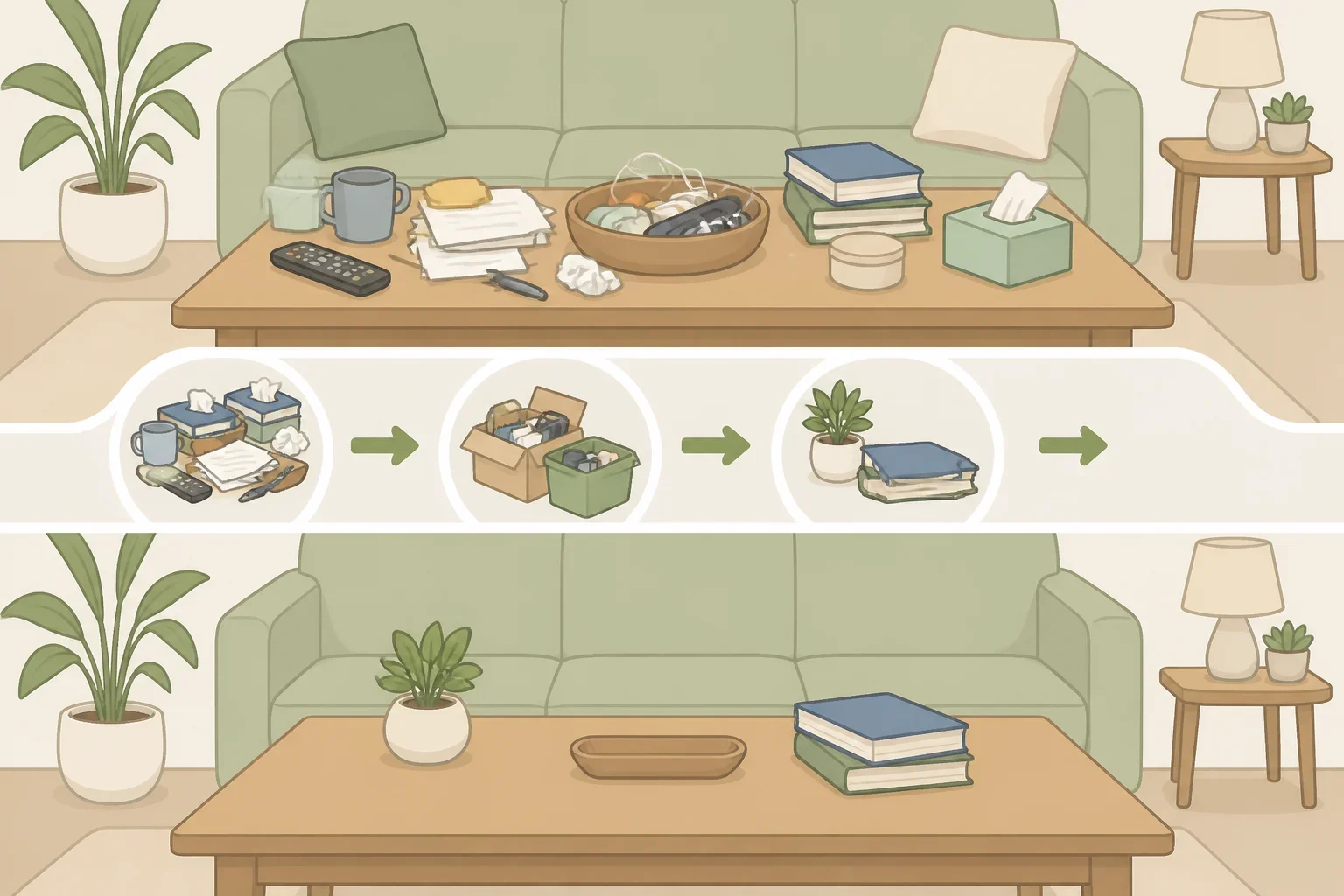
Choose the main living area’s most-seen surface, such as a coffee table, kitchen counter, or console. Remove everything that does not belong there, then return only the items that are used or intentionally displayed.
Two or three items can be a reasonable starting point, but it is not a magic number. In a small apartment, a remote-control tray and a lamp may be all the surface can comfortably hold. In a family room, leave room for the activity that happens there, whether that is reading, playing a game, or putting down a cup of tea.
Finish when the surface can be wiped and used without first moving a pile. If the same items return tomorrow, that is information about where they need to live, not a reason to blame anyone.
6. Rework the entryway for departures
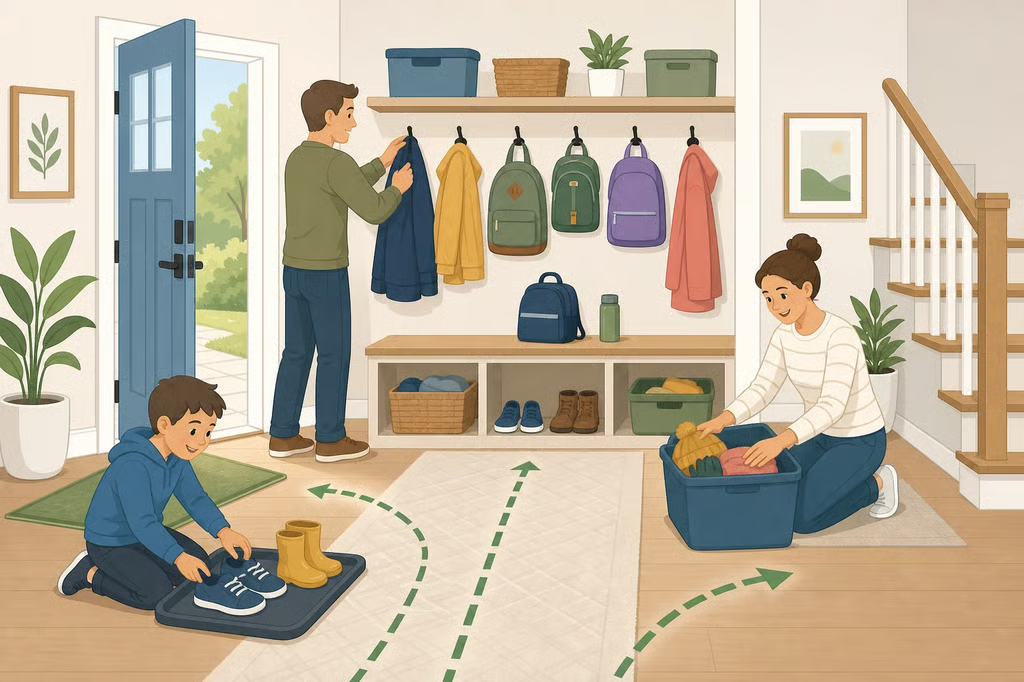
The entryway should support the way the household leaves in the morning. Place frequently used shoes where they can be reached, put hooks at a workable height for children if the wall and lease allow it, and give backpacks or work bags one dependable location.
A renter can use a freestanding hook rack, an existing chair, or a labeled tote rather than drilling into the wall. A household without children might use the same arrangement for laptop bags, gym items, or reusable shopping bags.
Test the setup during one departure. If someone still has to search for a bag or move three items to reach a coat, adjust the location. Stop once the most-used items can be picked up without a search.
7. Give paperwork one landing spot
Set up one tray, folder, or shallow box for mail, school forms, receipts, and documents that need attention. Separate action items from papers that can be recycled, but avoid creating a complicated filing system during the first pass.
For a couple, decide whether the tray is a shared system or whether each person needs a clearly marked section. For a family, keep forms that need signatures in the same place every time. A renter can use a portable file that fits on a shelf or inside a cabinet.
The system works when papers stop spreading across several counters. Empty the tray on a chosen day, but do not promise to process every document immediately. The first goal is containment.
8. Clear the meal and homework surface
Choose the kitchen counter, dining table, or another surface used for meal planning, homework, or paying bills. Remove objects that belong elsewhere and leave behind only what supports the next regular activity.
If the home has no spare table, clear one section of the counter instead. A couple can designate the same surface for dinner planning and household paperwork at different times. Families may want a small portable basket for homework supplies so the table can be cleared when it is time to eat.
Stop when one person can sit down or begin the task without first making room. A visually tidy room can still feel crowded or overstimulating, so judge this reset by function rather than by whether the space looks like a catalog.
Household chaos is broader than visible clutter. A systematic review of 112 studies found relationships between household chaos and parent-child conflict, less positive parenting, less effective discipline, and reduced parent-child closeness, according to the research summary. That does not mean a crowded counter causes conflict, but it is a useful reason to protect the surfaces shared activities depend on.
Professional organizer tips for fall routines
These final three resets are maintenance experiments. They are not steps proven by the studies to improve mornings or productivity. They simply make it easier to notice what the household uses and what keeps getting in the way.
9. Simplify one routine zone
Choose one toy bin, closet shelf, bathroom drawer, or spot where people prepare to leave. Move rarely used items out of the easiest-to-reach area and keep the things used most often where they can be found quickly.
Do not empty an entire child’s room or closet. Try one bin or one shelf first, and invite the child to help decide what belongs there when appropriate. In a small home, use a portable tote that can be put away rather than creating a new permanent zone.
The research connects household chaos with children’s executive functioning, but it does not test toy-bin editing. A 2021 meta-analysis combined 35 studies involving more than 16,000 children and found a significant association between household chaos and executive functioning, the skills involved in planning and focus. Use that finding as context, not as proof that fewer belongings will improve a particular child’s routine.
10. Clear one getting-ready surface
Pick one nightstand, bathroom counter, dresser top, or bedside shelf. Remove anything that does not belong, then return only the items needed for the next morning or evening.
A shared bathroom may need separate small containers for each person’s daily items. In a rental or small bedroom, a drawer or portable caddy can do the job without adding furniture. Leave enough open space to set down what is being used.
Stop when the surface can be cleaned and the daily essentials are visible. If an item is used every day but never put away, change its storage location rather than repeatedly returning it to the same inconvenient spot.
11. Schedule a small weekly maintenance reset
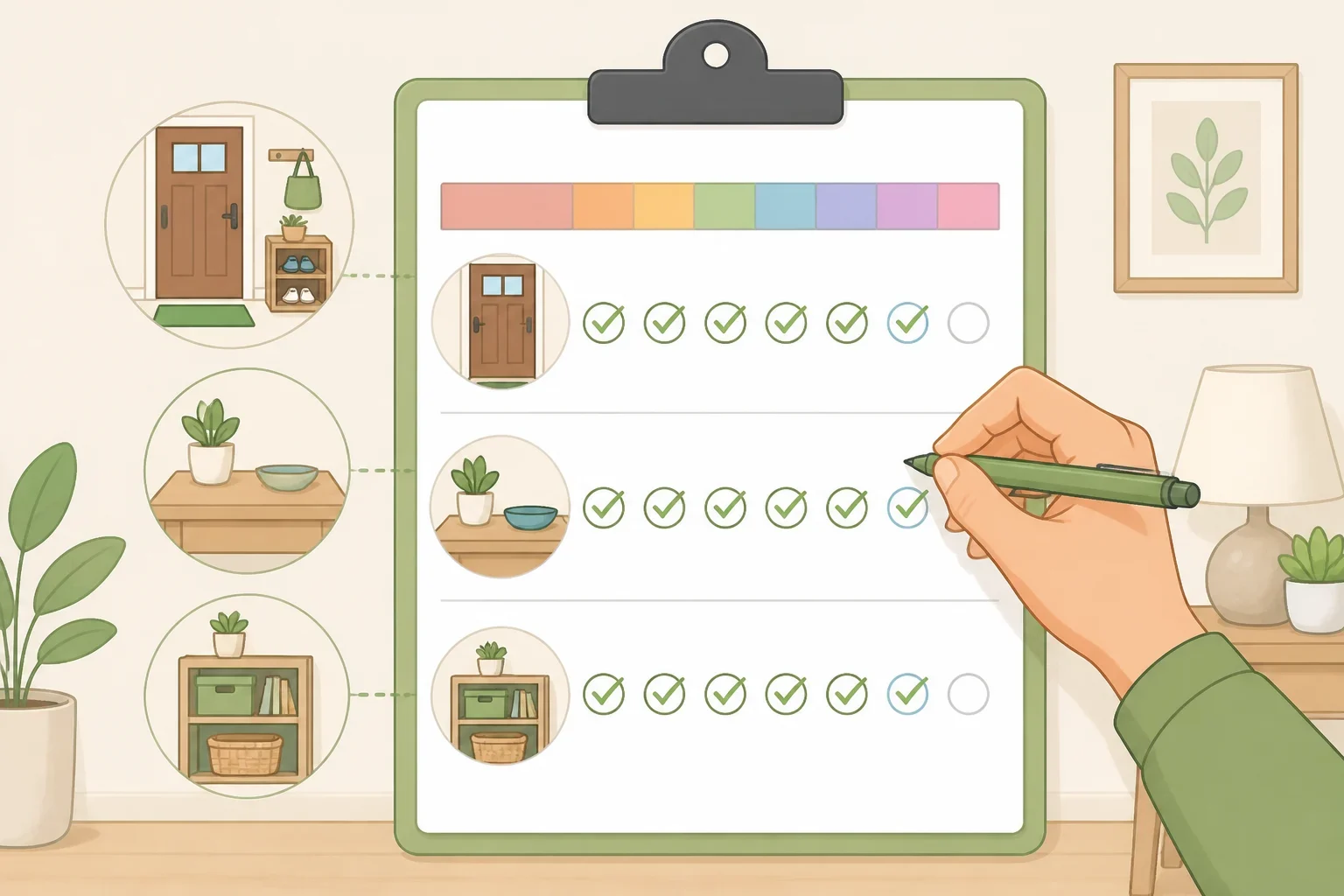
Choose one day and time for a 10- to 15-minute check. Walk through the entryway, the main shared surface, and one routine zone. Return misplaced items, clear new papers, and reopen the walking paths if needed.
This is a practical maintenance habit, not a proven mood treatment. If the household schedule changes, move the reset rather than treating the missed session as failure. A couple might do it before the weekend begins; a family might try it after dinner; a single renter might pair it with another weekly task.
Keep the ritual limited to what can be completed in the allotted time. Do not add labels, elaborate bins, or a larger organizing project until the basic system has had a fair trial.
A two-week plan for your home
On the first day, clear the walking paths and create the entryway drop zone. On the next available day, reset one frequently used surface. During the following week, try the 15-minute session twice, then choose one routine zone to simplify.
The research supports caution as much as it supports action. Household disorder has been associated with stress markers, mood, family strain, and later falls, but the studies do not show that these 11 actions directly improve productivity or solve every source of household stress. Start with the places that affect safety and daily movement, test a simple system, and add only what the home can realistically maintain.
