
- How to stop paying only the minimum on credit cards
- Why paying only the minimum keeps you in debt
- Step 1: Read the statement before changing the payment
- Step 2: Build a payment around the budget
- Step 3: Set the payment and protect the due date
- Step 4: Stop new charges from undoing the progress
- Step 5: Choose an order for multiple cards
- What to do when more than the minimum is not affordable
- Strategies to pay off credit card debt faster: Is consolidation right?
- Take the next step today
How to stop paying only the minimum on credit cards
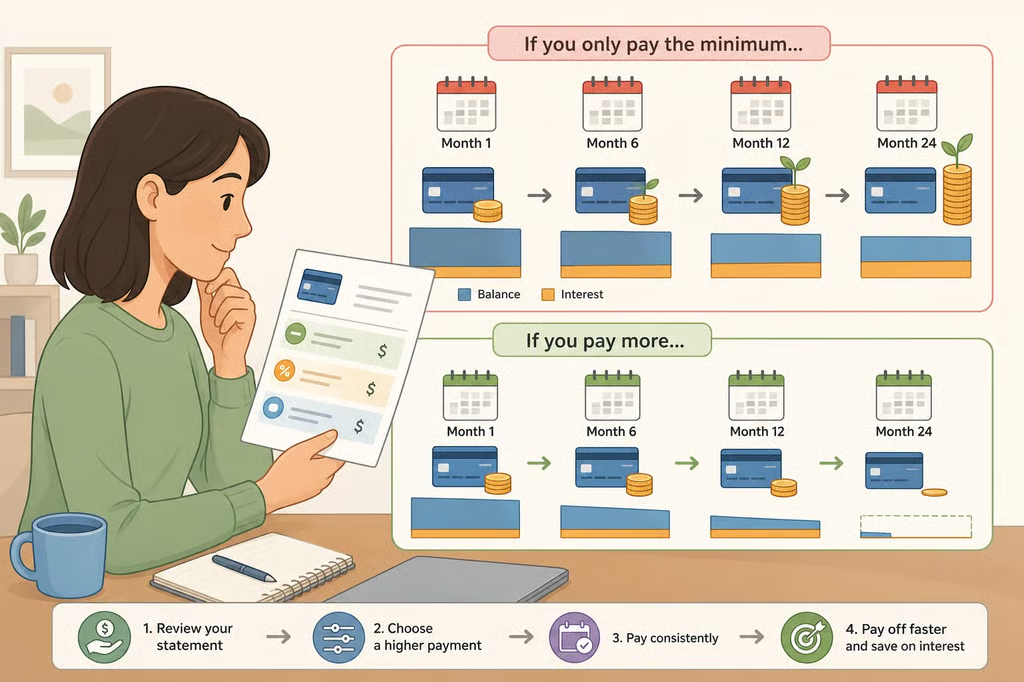
The minimum payment keeps a credit card account current, but it usually is not a strong payoff plan. To learn how to stop paying only the minimum on credit cards, start with the numbers on each statement, choose a payment your household can sustain, and stop adding new charges where possible.
A hypothetical example from MyCreditUnion.gov shows how quickly a small required payment can stretch a balance. A $1,500 purchase at a 19% interest rate could take more than eight years, or 106 payments, to repay when the minimum is calculated at 4% of the balance. Under that example’s assumptions, the borrower pays more than $889 in interest, without adding new purchases or late fees.
The same example uses a 2.5% minimum payment, which starts at $37.50 a month. That lower payment takes more than a decade, or 208 payments, and costs more than $2,138 in interest. These are hypothetical calculations, not a prediction for every card. Minimum-payment formulas, interest rates, fees, and repayment terms vary by issuer.
The goal is not to shame anyone who is paying the minimum to stay current. A payment that fits the budget is better than skipping a bill. The plan below helps move an account from simply staying current to steadily reducing what is owed.
Why paying only the minimum keeps you in debt
A credit card minimum payment is not always a fixed percentage of the balance. The formula depends on the issuer and the card agreement. The 4% and 2.5% calculations in the example above illustrate possible formulas, so check the payment formula in the card agreement rather than assuming another account works the same way.
Interest and fees can consume much of a minimum payment before the principal balance falls. A Managing Debt example describes a $1,000 balance at a 13% interest rate with a 2% minimum payment of $20. A significant portion of that payment goes toward interest, leaving only a small amount to reduce the principal. That example does not mean every card allocates payments in exactly the same way.
Fees, high interest rates, and continued spending make the problem harder. If new purchases keep landing on the card, the balance may not appear to shrink even when payments are being made. The minimum due is best treated as a floor for keeping the account current, not as a complete repayment strategy.
Paying the full statement balance each month can probably avoid interest, but the card’s terms matter. A carried balance or special transaction, such as a cash advance, may have different rules. Paying only part of the bill generally means paying interest on the amount left unpaid.
Step 1: Read the statement before changing the payment
Pull the latest statement for each credit card. Do not rely on the balance shown in a budgeting app alone. The statement contains the details needed to build a payment that is realistic and timely.
Write down:
- Current balance
- Minimum payment due
- Payment due date
- Interest rate
- Minimum-payment formula, if shown
- Annual, late, or other account fees
- Minimum-payment payoff disclosure
The payoff disclosure estimates how long repayment could take and how much it could cost if only the minimum is paid under the statement’s assumptions. It is a projection, not a guarantee. New charges, rate changes, fees, and missed payments can change the result.
Check the late-payment language, too. The MyCreditUnion.gov example says an issuer may charge up to $27 for a first offense and up to $38 for a later one, but actual fees and legal limits can vary by issuer and applicable law. Treat those figures as an example, not a universal fee schedule. (MyCreditUnion.gov)
If there are several cards, make one list with a row for each account. Seeing the balances, rates, and due dates together makes it easier to choose a plan and avoid overlooking a payment.
Step 2: Build a payment around the budget
Before choosing an extra payment, make a bare-bones budget. List housing, utilities, food, transportation, insurance, and other bills that must be paid. Then account for the minimum payment on every credit card.
The amount left is not automatically available for debt payoff. A small buffer for irregular household costs can help keep one unexpected bill from sending the card balance back up. The budget should show what can safely be paid, not an ideal number that works only in a perfect month.
Choose a fixed payment that is higher than the minimum and can be repeated. An extra $20 to $40 per statement is a useful example, not a rule. If an account requires a $60 minimum, for instance, a planned payment might be $80 or $100, provided the higher amount still leaves room for essential bills.
A sustainable $40 is more useful than an ambitious $200 that lasts for one month. If income changes, revisit the payment rather than abandoning the plan completely. Consistency is the first practical goal.
Step 3: Set the payment and protect the due date
Pay at least the minimum by the due date on every account. Paying more than the minimum can shorten repayment and reduce potential interest charges, but missing the minimum may lead to a higher interest rate, fees, and credit damage. (MyCreditUnion.gov)
Set an automatic payment for at least the minimum if the issuer and bank account allow it. Then schedule the planned extra amount separately, or set one larger automatic payment if that timing works with the household budget.
Automation helps, but it is not a substitute for checking the account. A changed bank balance, returned payment, or updated minimum can create a problem if it goes unnoticed. Keep enough money available for the scheduled payment and review the statement each month.
Step 4: Stop new charges from undoing the progress
The cleanest way to pay off credit card debt faster is to stop using the card while paying it down. Put the card away, remove it from saved online checkouts, or use another payment method for expenses already covered in the budget.
That may not be possible immediately for every household. If the card is covering an essential expense, add that expense to the budget and include the new charge in the payoff calculation. Otherwise, the planned payment may simply cover new spending instead of reducing the old balance.
Avoid treating available credit as extra income. The balance is easier to track when the account is used only for repayment. If the card must remain in use, review the balance and new charges each month so the payment reflects what is actually owed.
Step 5: Choose an order for multiple cards
Pay the minimum on every card first. Then direct the extra payment to one target account instead of spreading a small extra amount across every balance.
There are two straightforward ways to choose the target:
- Start with the card carrying the highest interest rate.
- Start with the card carrying the smallest balance.
The first choice focuses on the rate. The second can eliminate one account sooner and simplify the list of bills. Either approach requires continued minimum payments on the other accounts, and neither will work well if new charges keep rebuilding the target balance.
When the target card is paid off, move that payment to the next account. For example, if the first card’s minimum is $35 and the planned extra payment is $40, the next target can receive the amount that had been going to the first card, subject to the household budget.
Review the plan monthly. Compare the new balance with the previous statement, check whether interest or fees changed, and adjust the payment if the budget has changed. The purpose of the review is to catch problems early, not to judge the pace.
What to do when more than the minimum is not affordable
Sometimes the budget has no safe room for an extra payment. Staying current is still the immediate priority. Do not skip the minimum in an attempt to make an aggressive payoff plan work.
Call the card issuer before missing a payment and ask whether a payment plan is available. Some companies might allow a reduced monthly payment until the balance is repaid, although that option is not guaranteed. Ask the issuer to explain the terms before agreeing to anything.
A credit counselor may also be able to help create a workable plan. Debt-management counseling, debt settlement, and a consolidation loan are different services, so ask what the organization actually provides before sharing payment information or signing an agreement.
Be cautious with companies that promise to eliminate debt, stop collection calls, or solve the problem in exchange for an upfront fee. The consolidation guidance says legitimate companies should be realistic about available options, should not charge upfront fees, and should contact consumers only after consumers have expressed interest.
Unpaid debt can lead to a lawsuit. If a court enters a judgment, a creditor or collector may be able to seek an order involving a bank account or wages. That possibility is a reason to respond to notices and seek qualified help early, not a reason to assume garnishment is automatic.
Strategies to pay off credit card debt faster: Is consolidation right?
Debt consolidation combines multiple debts into one loan or line of credit. It may simplify payments, provide a fixed repayment schedule, or lower the interest rate. Those benefits are conditional. A new loan lowers the total cost only when its rate, fees, and repayment term compare favorably with the existing debts.
Before applying, compare:
- The new interest charges and transfer or origination fees
- The total repayment amount
- The payoff date
- The monthly payment
- What happens to the old cards after the transfer or loan
- How new spending will be handled
A lower monthly payment can be misleading if it comes from stretching repayment over a longer period. Consolidation may also be a poor fit if the cards are likely to be run up again after the balances are moved.
Common options carry different trade-offs:
- Balance-transfer card: A low or 0% introductory rate may apply for a limited period, followed by a higher rate. The source gives 3%, or $30 on $1,000, as an example of a transfer fee, not a standard fee. Compare the fee, promotional period, required payment, and rate after the promotion. (MyCreditUnion.gov)
- Personal loan: A fixed term may make the finish line easier to see, but origination fees can increase the cost. Compare the full repayment amount, not only the monthly bill.
- Home-equity loan or line of credit: Using home equity may provide a lower interest rate, but failure to repay on time can put the home at risk of foreclosure.
- Retirement-account loan: This may carry a lower interest rate, but early-distribution penalties, tax liabilities, and lost investment growth are possible if the loan is not repaid as required.
Home-equity and retirement decisions deserve advice from a qualified financial or tax professional because terms and consequences vary. Shop around, review the agreement, and compare the total cost before committing.
Take the next step today
Pull out the most recent statement for each card. Write down the balance, interest rate, minimum due, due date, and projected minimum-payment cost.
Then choose one sustainable payment above the minimum and schedule it. Stop or limit new charges so the payment can reduce the balance instead of replacing new spending.
If that payment does not fit after essential bills, contact the issuer or a credit counselor before a payment is missed. If consolidation is on the table, compare total costs and payoff dates side by side before signing anything. That is how to break the credit card minimum payment cycle without replacing one stressful payment with another.
