
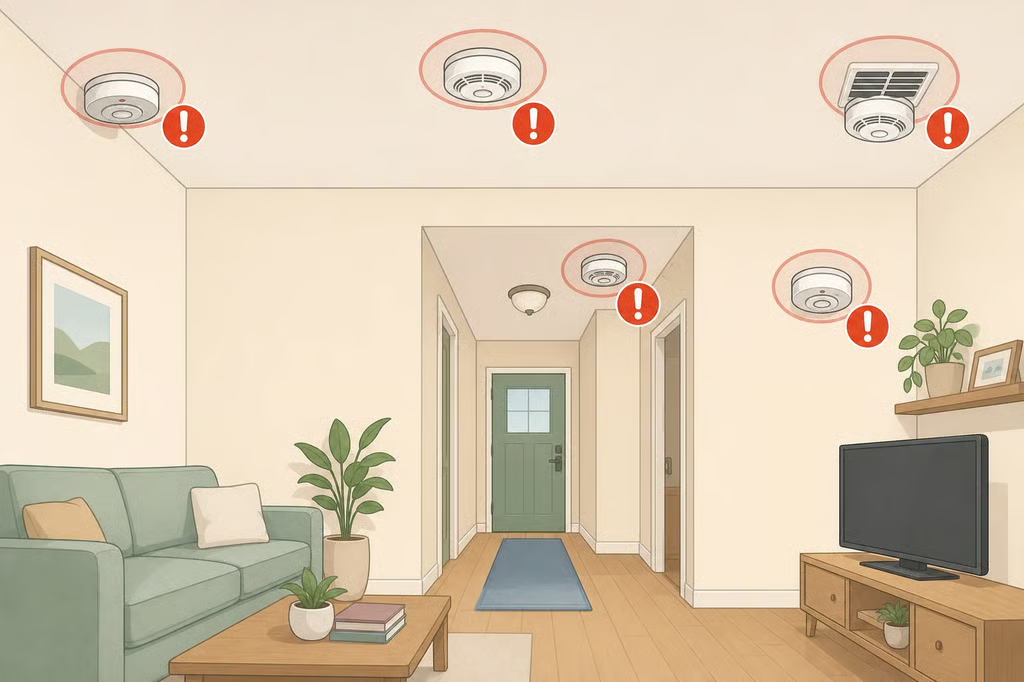
Where Not to Put Smoke Detectors: 5 Placement Mistakes
If a smoke alarm near the kitchen or bathroom keeps sounding, do not take out the battery and leave it that way. Move it to a better location while preserving the required coverage. This guide explains where not to put smoke detectors, where to place them instead, and what to do when an alarm still causes trouble.
The stakes are straightforward. The death rate per 1,000 home structure fires is approximately 60% lower in homes with working smoke alarms than in homes with no alarms or none that operated, according to NFPA research published in 2024. Poor placement is not the main reason alarms fail. Missing, dead, or disconnected power sources are. But repeated nuisance alarms can still lead people to ignore or disable a unit.
Smoke alarm and smoke detector are used interchangeably in everyday conversation. Technically, a detector senses smoke and connects to a larger fire alarm system, while an alarm includes the sensor and the speaker that alerts people in the home, as NFPA explains.
Where should smoke alarms be installed?
Start with coverage before correcting a troublesome location. Place alarms:
- Inside every bedroom
- Outside each sleeping area
- On every level of the home, including the basement
Properly interconnected alarms can sound throughout the home when one detects smoke. That connection may be wired or wireless, depending on the system. NFPA says interconnected alarms are more likely to alert occupants when a fire starts elsewhere in the building.
That means moving an alarm away from a kitchen or bathroom should not mean removing coverage from that part of the home. Find another nearby location that keeps the alarm within the required coverage pattern while avoiding steam, cooking smoke, drafts, or extreme temperatures.
If the home is being renovated or built, check placement and interconnection requirements with the local building department or fire department. Local code and the existing wiring can affect what is allowed, particularly when a hardwired unit is being moved.
Smoke alarm placement mistakes to avoid
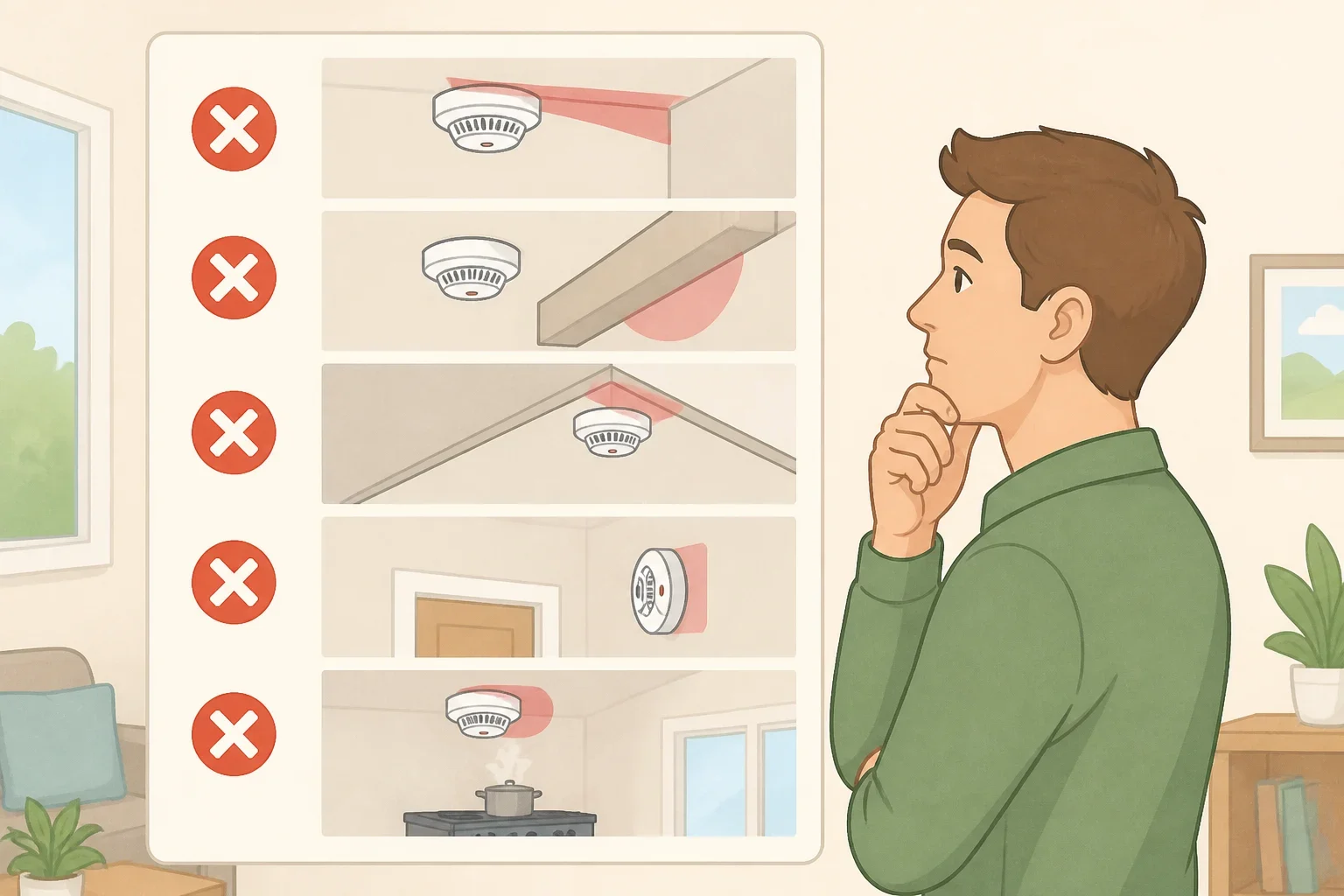
Use the same decision each time: identify the problem location, understand what could interfere with the alarm, then move it without creating a gap in coverage.
1. Keep alarms away from the stove or oven
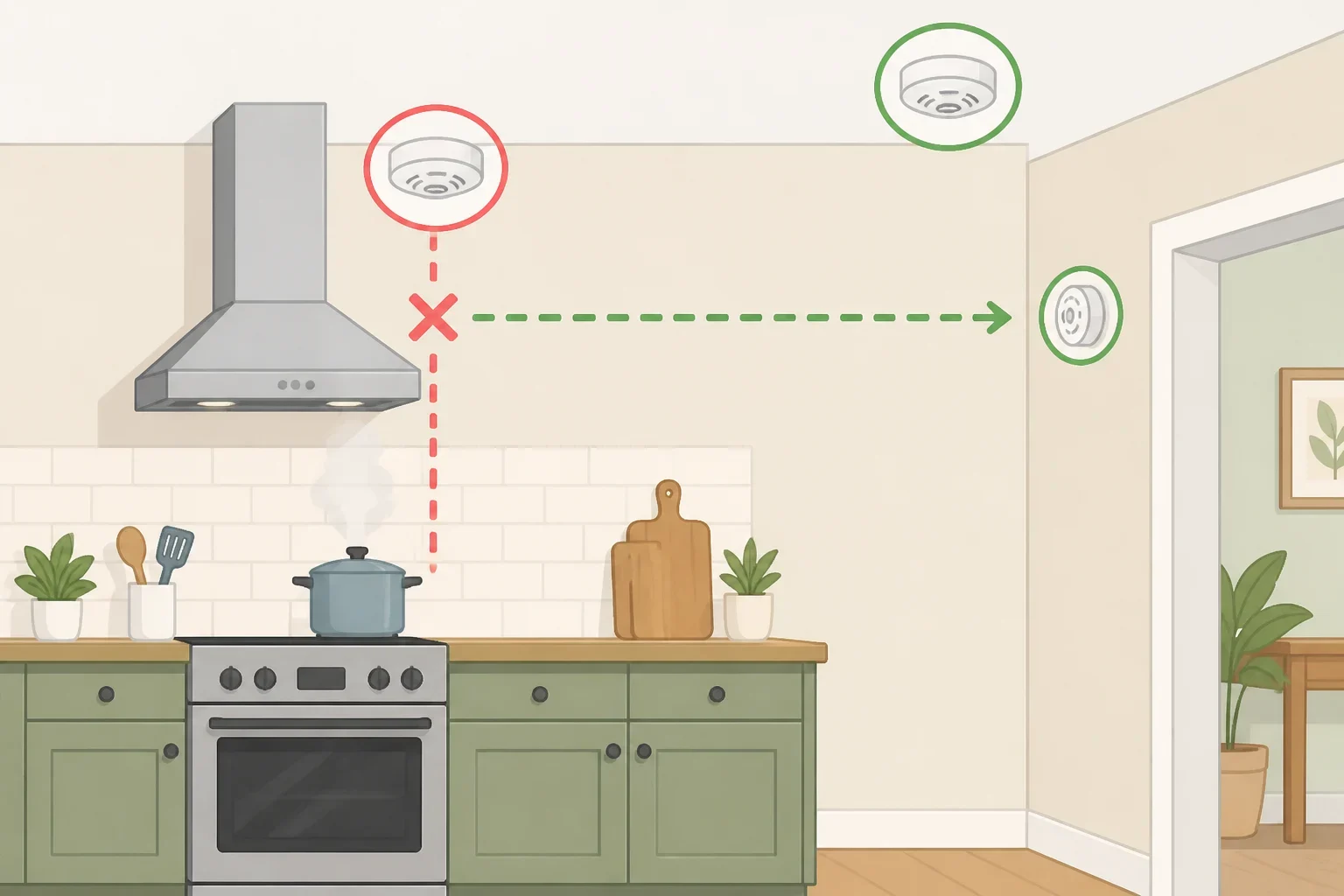
Cooking smoke is one of the most common reasons an alarm sounds when there is no fire. For the fewest unwanted alarms, place a smoke alarm at least 20 feet from cooking appliances, according to NFPA.
If the room is small and that distance is not possible, the alarm may be placed 10 to 20 feet from the stove only when it is a photoelectric model, has a hush feature, or is listed as resistant to common cooking smoke. Do not interpret 10 feet as the preferred distance for every alarm.
The safer spot is on the ceiling or high on a wall outside the kitchen, at least 20 feet from the cooking appliances when the layout allows. Keep the required alarm coverage intact. If the only available location is closer than 20 feet, check the alarm’s label and manufacturer instructions before choosing a model with the appropriate features.
Alarm type can make a difference, but it does not replace good placement. Ionization alarms tend to respond more quickly to small particles from flaming fires, while photoelectric alarms tend to respond more quickly to the larger particles associated with smoky, smoldering fires. Consumer Reports reported in 2022 that ionization units are prone to false alarms from burnt food and steam, while photoelectric units may be better around kitchens. For broad protection, NFPA recommends both types or a combination ionization-photoelectric alarm.
2. Do not mount an alarm right beside a bathroom door
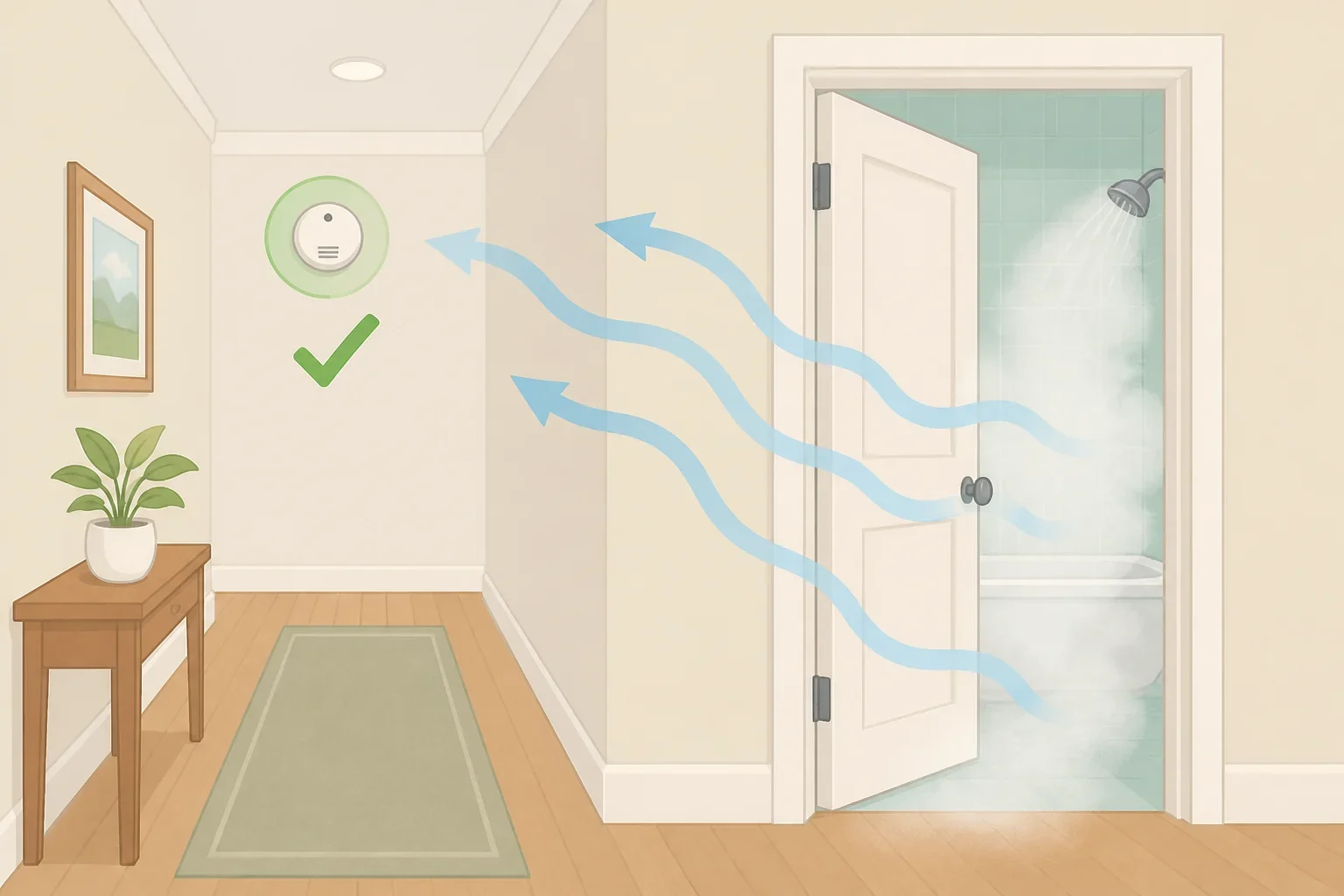
Steam from a shower can enter the sensing chamber and trigger an unwanted alarm. High humidity and a nearby humidifier can create similar problems, according to NFPA.
When an alarm belongs in a hallway near a bathroom with a shower, place it at least 36 inches from the bathroom door. The safer spot is farther down the hall, where the alarm remains close enough to protect the sleeping area without sitting in the direct path of steam.
Do not solve the problem by taking the alarm down altogether. If the hallway is narrow, measure from the door before drilling new holes. A few feet can make the difference between a unit that repeatedly sounds after a shower and one that remains ready to respond to smoke.
3. Avoid windows, vents, and HVAC supply registers
Do not install an alarm in the direct path of moving air. That includes areas near openable windows, ceiling fans where air is being pushed across the room, or HVAC supply registers.
NFPA advises avoiding locations with air movement or drafts, including near windows and HVAC air supplies. Moving air can affect how smoke reaches the sensor, so a unit placed directly beside a register may not respond as intended.
Move the alarm to a nearby ceiling location outside the airflow path. If the ceiling has no suitable spot, choose a high wall location that is still part of the required coverage area and away from the draft. Look at the room before marking the holes: identify where air enters, where windows are opened, and where a fan or vent sends air across the ceiling.
4. Keep smoke alarms out of unconditioned temperature extremes
A freezing garage may seem like a convenient place for an alarm, especially when the space is attached to the home. It is generally a poor environment for a standard smoke alarm unless the product is specifically rated for it.
Smoke alarms are designed for a temperature range typically around 40°F to 120°F, according to NFPA. Temperatures outside that range, including freezing conditions in a garage, may contribute to false alarms. The specific product instructions are the final authority, so check the operating range on the alarm before installing it.
Move the smoke alarm into the conditioned portion of the home, where it can still provide the required coverage. A garage may also affect carbon monoxide planning. If the home has an attached garage or fuel-burning equipment such as an oil or gas furnace, boiler, water heater, fireplace, or generator, NFPA says carbon monoxide detection is also needed inside the house. Smoke and carbon monoxide protection serve different purposes, so do not treat one as a substitute for the other.
5. Do not place an alarm in the exact apex of a pitched ceiling
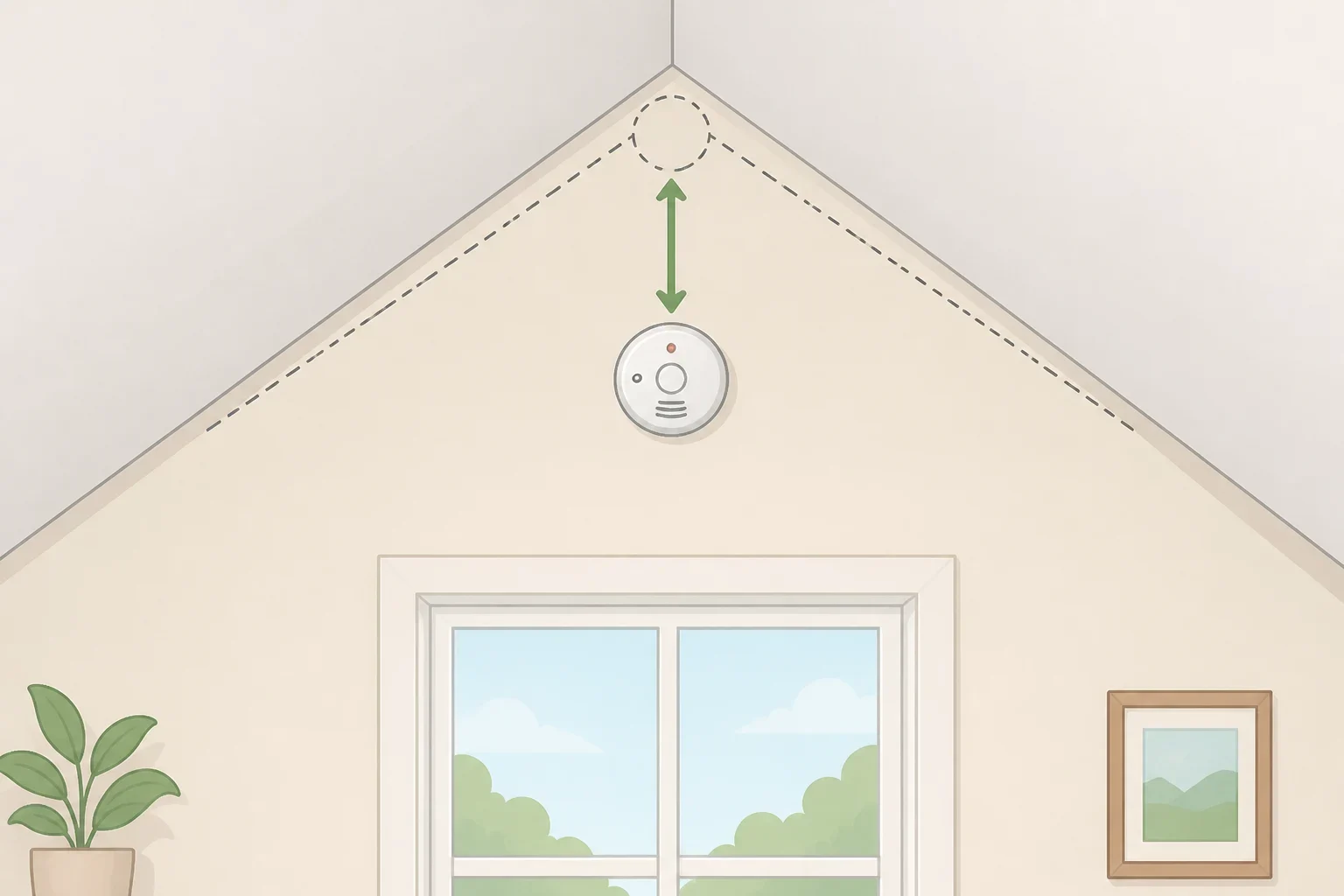
Smoke can collect in a pocket at the very peak of a pitched ceiling. For a pitched ceiling, place the alarm within 36 inches of the peak, but not within the top 4 inches of the apex, as NFPA advises.
The safer spot is slightly down from the peak, positioned according to the ceiling shape and the manufacturer’s instructions. This is a detection concern, not the same nuisance-alarm problem caused by cooking smoke or shower steam. The goal is to avoid the dead-air pocket while keeping the alarm close enough to the peak for smoke to reach it promptly.
Use extra caution with very high or unusual ceilings. NFPA research published in 2023 found inconsistency in design and code enforcement for smoke detector spacing on ceilings higher than 10 feet. If the ceiling is unusually high, vaulted, open to another story, or difficult to reach, ask the local fire department or a qualified professional before choosing a location.
Why nuisance alarms still need attention
A smoke alarm that sounds too often can become easy to dismiss. That is dangerous even when the original cause is harmless cooking smoke or shower steam. NFPA notes that if an alarm in the kitchen sounds too often, moving it may solve the problem.
The broader failure data is sobering. From 2018 through 2022, fire departments responded to an estimated average of 19,119 home fires each year in which smoke alarms should have operated but did not. Those fires caused an average of 403 deaths and 1,052 injuries annually, according to NFPA.
The report identifies missing or nonfunctional power sources, including missing or disconnected batteries, dead batteries, and disconnected hardwired alarms, as the most common factors when alarms failed. Placement does not explain all alarm failures, but a poorly chosen location can create a practical temptation to silence a unit. Relocation is safer than disconnection.
What to do if an alarm keeps sounding
1. Leave first
Treat a sounding alarm as a real emergency until the cause is clear. Exit the home immediately and follow the household fire-escape plan. If there is smoke, fire, or a carbon monoxide warning, call 911 from outside.
A repeated pattern of four beeps followed by a pause indicates a carbon monoxide alarm, according to NFPA. Carbon monoxide cannot be seen or smelled. Leave immediately and call 911 so the fire department can investigate.
Only troubleshoot after everyone is safe. Sound patterns can vary by model, especially with combination smoke and carbon monoxide alarms, so use the manufacturer’s instructions rather than relying on a pattern alone.
2. Check for steam, cooking smoke, or airflow
Once there is no emergency, consider whether the alarm is too close to a bathroom, cooking appliance, window, or HVAC register. Move it according to the distances above while maintaining the required coverage.
Do not assume that a quiet alarm is a fixed alarm. A properly placed unit can still sound when smoke is present.
3. Clean the unit carefully
Dust, dirt, and spiders can get inside an alarm and cause false sounds. NFPA says the unit can be cleaned with a vacuum or compressed air. Cleaning may resolve the problem, but it does not make an old or failing alarm reliable again.
Follow the product instructions and reinstall the alarm before leaving the area. Never leave the home without the required alarm in place.
4. Check the battery and manufacture date
A short chirp usually signals an issue with the alarm. For a unit with replaceable batteries, replace the battery at least once a year and test the alarm every month. Sealed 10-year alarms do not need routine battery replacement, but they still need monthly testing.
Read the manufacture date on the back label. Smoke alarms should be replaced every 10 years, while combination smoke and carbon monoxide alarms should be replaced after 7 to 10 years, according to NFPA. If a newer alarm continues chirping after a fresh battery, replace the unit instead of repeatedly replacing batteries.
A safer smoke alarm check for the home
Walk through the home and inspect each alarm one at a time:
- Confirm coverage inside bedrooms, outside sleeping areas, and on every level, including the basement.
- Measure at least 20 feet from cooking appliances when possible.
- Keep hallway alarms at least 36 inches from bathroom doors.
- Move alarms out of direct drafts, windows, and HVAC supply paths.
- Check the product’s temperature range before using an alarm in an unconditioned space.
- Keep alarms out of the exact apex of a pitched ceiling.
- Verify the manufacture date on the back label.
- Test every alarm monthly.
- Replace batteries at least yearly when the unit uses replaceable batteries.
- Ask the local fire department or a qualified electrician before changing a hardwired system, remodeling, or drilling into a difficult high-ceiling location.
The best placement balances two needs: smoke must be able to reach the sensor quickly, and everyday cooking, bathing, airflow, and temperature changes should not make the alarm impossible to live with. Preserve the required coverage, move problem units instead of disabling them, and get local guidance when the room or wiring makes the answer unclear.
